AI-generated content for informational purposes only. Data should be independently verified. Specifications are drawn from open-source reporting and may not reflect classified assessments.
Iran's drone fleet serves a specific strategic function in mixed strike operations: arriving in large numbers to exhaust interceptor stocks, force defenders to expend expensive missiles against cheap platforms, and saturate radar and sensor networks. At a ratio where each interceptor costs 2-5x the cost of each drone, mass saturation attacks create cumulative economic pressure that no layered defence can sustain indefinitely.
Overview
One-way attack (OWA) drones — sometimes called loitering munitions or kamikaze drones — are single-use weapons that fly to their target and detonate on impact. The Shahed-136 has become the signature Iranian OWA platform, notable for its delta-wing configuration, characteristic propeller engine sound, and widespread export — Russia has deployed the same design (designated "Geran-2") extensively in Ukraine, where extensive battlefield recovery has revealed detailed supply chain information.
Drones are the slowest weapon type in Iran's mixed salvo, arriving hours after ballistic missiles and cruise missiles. Their role is primarily to maintain defender activation, exhaust interceptor magazines, and exploit gaps opened by earlier salvos. The Shahed-238 jet variant represents a deliberate evolution toward higher speed and GPS-jam-resistant guidance.
Iran manufactures the Shahed-136 in large quantities, enabling salvos of hundreds per operation. The Mohajer-6 represents a distinct category — a reusable medium-altitude long-endurance (MALE) platform used for both intelligence, surveillance, and reconnaissance (ISR) and precision strike, not mass saturation.
Arsenal & Specifications
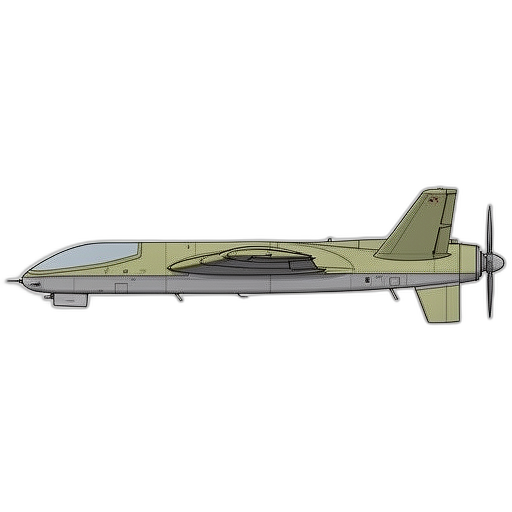
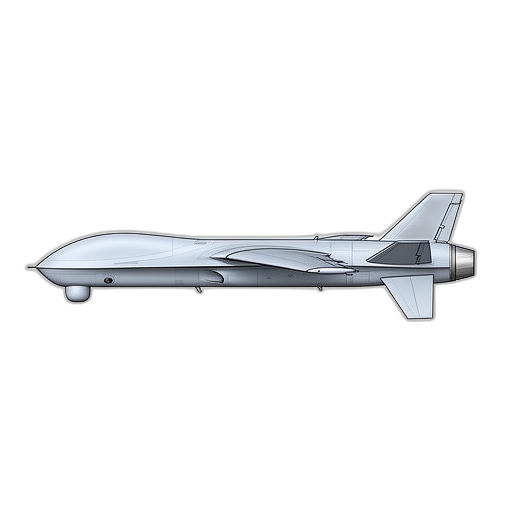
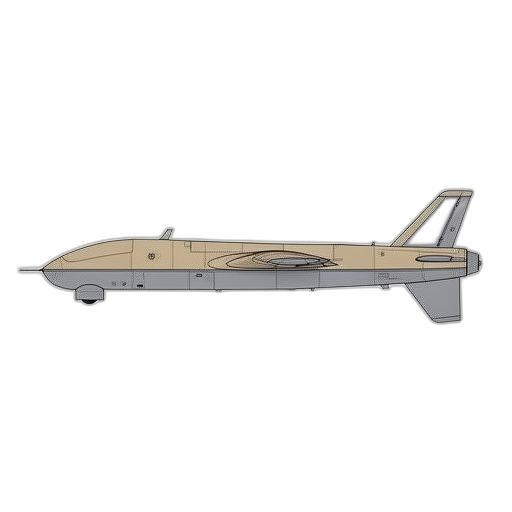
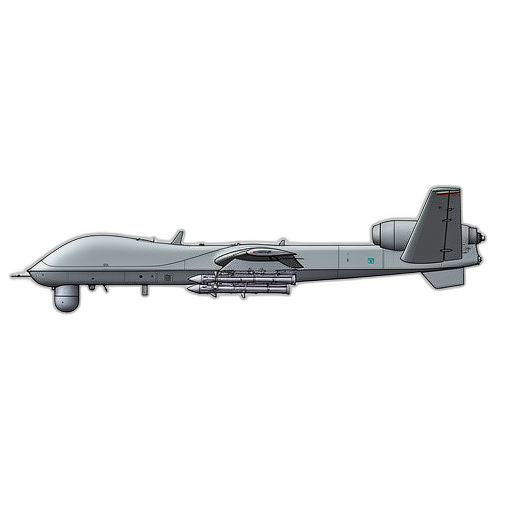
| System | Type | Propulsion | Range | Warhead | Speed | Navigation / Guidance | Intro. | Est. Inventory |
| Shahed-136 | OWA | Piston (Mado MD-550; Iranian copy of Limbach L550E) | ~2,000 km | ~40-50 kg blast-frag | ~185 km/h | GPS (GLONASS/BeiDou) + INS; no terminal seeker | ~2021 | 1,000+ (mass produced; hundreds/month) |
| Shahed-238 | Jet OWA | Small turbojet (Toloue-10 or similar; Iranian-made) | ~1,500-2,000 km | ~85 kg | ~500 km/h | GPS/INS + optional IR terminal seeker; some variants with anti-radiation seeker | 2023 | ~100-300 (scaling) |
| Shahed-131 | OWA | Piston (same supply chain as Shahed-136) | ~900 km | ~15 kg | ~185 km/h | GPS/INS | ~2020 | 500+ |
| Mohajer-6 | MALE UAV | Rotax 912 derivative (Austrian-origin; sourced via intermediaries) | ~200 km combat radius | Guided munitions up to ~100 kg (Qaem-series) | ~200 km/h | GPS + data link + EO/IR sensor suite | 2017 | ~50-100 |
Amber border = OWA/piston. Orange border = jet-powered OWA. Blue border = reusable MALE UAV. Inventory estimates are open-source; classified assessments may differ significantly.
Navigation & Guidance Deep Dive
Iran's drone guidance has evolved in direct response to coalition countermeasures. Understanding each guidance mode explains why the Shahed-238's optional seekers represent a qualitative shift in the threat.
GPS / GLONASS / BeiDou
Primary navigation — Shahed-136, 131, 238, Mohajer-6
OWA drones use satellite navigation as primary guidance, flying pre-programmed waypoints with no real-time operator input. Originally GPS-only, Iran has integrated Russian GLONASS and Chinese BeiDou constellations to reduce dependence on any single system. Vulnerable to dedicated GPS jamming — Israel and coalition partners operate extensive jamming capabilities that have visibly degraded Shahed-136 accuracy in operational use.
Inertial Navigation System (INS)
Jam-resistant backup — all platforms
Basic inertial navigation provides dead-reckoning when satellite signals are lost or jammed. Gyroscopes and accelerometers track movement from a known starting point. Accuracy degrades significantly over long flights without satellite correction — a 2,000 km flight with GPS jammed throughout might see tens of kilometres of error at impact. INS alone is insufficient for precision strike but adequate for area attacks against large infrastructure.
Infrared (IR) Terminal Seeker
GPS-jam resistant terminal phase — Shahed-238 variants
An IR seeker activates in the final approach phase, homing autonomously on heat signatures — engines, power plants, vehicle exhausts. Once the seeker locks, GPS jamming has no effect; the drone homes on thermal contrast. This directly counters Israel's primary electronic countermeasure against the Shahed-136. Effectiveness depends on target heat signature and atmospheric conditions; sophisticated targets with thermal masking can defeat IR seekers.
Anti-Radiation Seeker
Radar-hunting variant — Shahed-238 (reported)
Homes on radar emission signatures, specifically designed to target air defence radars. Forces defenders into a dilemma: keep radar active (and attract the drone) or turn it off (and lose tracking of other threats). Even if the drone misses, the tactic forces radar operators into "shoot and scoot" patterns that degrade overall battle management. The combination of IR and anti-radiation seekers across a mixed salvo makes static radar placement extremely hazardous.
Swarm Saturation — Live Simulation
Overhead View: Saturation Attack
Hundreds of drones launched from multiple Iranian provinces converge simultaneously. Blue interceptor lines represent defence systems firing — but finite magazines cannot stop every drone. Simulation runs automatically on scroll.
Red dots = Shahed-136 / OWA drones. Blue lines = interceptor engagements. Amber dots = penetrating drones. Intercept rate ~85-92% based on observed TP operations — but at scale, even 8-15% penetration across 300+ drones means 25-45 drones reaching targets.
System Spotlights
The Shahed-136 is the cornerstone of Iran's drone saturation doctrine. Its characteristic delta-wing configuration and loud pusher-propeller engine have made it audible to civilians across multiple conflict zones. Russia's adoption of the design as the "Geran-2" created a second production stream and extensive battlefield-recovery data from Ukraine.
The drone carries a 40-50 kg blast-fragmentation warhead capable of damaging infrastructure and lightly armoured vehicles, but insufficient against hardened military targets. Its strategic value is volume: Iran can launch hundreds in a single salvo, arriving over an extended window to maintain defender activation for 5-10 hours after the ballistic missile salvo.
Lineage
Delta-wing design of Iranian origin; aerodynamically similar to US-origin Teledyne Ryan Firebee targets but indigenously developed
Propulsion
Mado MD-550 piston engine — Iranian-manufactured copy of the German Limbach L550E; approximately 26 hp
Navigation
GPS (multi-constellation: GPS, GLONASS, BeiDou) + INS backup; pre-programmed waypoints; no operator link in flight; no terminal seeker
Combat usage
TP1 (April 2024): ~170 launched; TP3: ~100+ launched; TP4 (2026): hundreds across multiple salvos; also deployed extensively by Russia in Ukraine (as Geran-2)
Western components documented: Ukrainian battlefield recovery of downed Geran-2 (Shahed-136) drones identified electronic components from Western commercial suppliers including US, European, and Japanese-origin capacitors, microcontrollers, GPS modules, and clock oscillators. This indicates Iran's industrial reliance on dual-use commercial electronics sourced via third-country intermediaries, despite export controls.
2.7x
faster than Shahed-136
The Shahed-238 represents a direct Iranian response to the interception of Shahed-136 drones. By switching from a piston pusher to a small turbojet engine, Iran produced a drone approximately 2.7 times faster than its predecessor — compressing the defender's engagement window significantly and making gun-based intercepts substantially harder.
At 500 km/h, the Shahed-238 approaches the lower end of subsonic cruise missile speeds, blurring the tactical boundary between drone and cruise missile categories. It remains slower than fighter aircraft and can still be intercepted, but at greater expense and complexity than engaging the Shahed-136.
The optional IR terminal seeker is the most operationally significant upgrade: it activates in the final approach and homes on heat signatures, making GPS jamming — Israel's most effective countermeasure against the Shahed-136 — irrelevant once the seeker has locked on. The reported anti-radiation seeker variant adds a direct threat to air defence radars themselves.
Propulsion
Toloue-10 or similar small turbojet; Iranian-manufactured; thrust ~400-500 N estimated
Navigation
GPS/INS primary; optional IR terminal seeker (GPS-jam resistant); optional anti-radiation seeker (radar-hunting)
Why it matters
The combination of higher speed + IR seeker directly defeats the two primary countermeasures used against Shahed-136: gun/fighter intercepts (less time available) and GPS jamming (seeker independent)
Supply chain
Indigenous turbojet; IR seeker technology of uncertain origin; likely incorporates some commercially-sourced optical and electronic components
The Shahed-131 is a smaller predecessor to the Shahed-136, sharing the same propulsion, airframe concept, and supply chain but in a more compact configuration. Its 15 kg warhead is significantly smaller — adequate for soft targets and radar installations but limited against hardened infrastructure.
Operationally, the Shahed-131 is typically employed alongside the Shahed-136 in mixed drone salvos, adding volume without requiring identical manufacturing. The shorter range (approximately 900 km vs 2,000 km) limits its use to targets accessible from western Iranian launch zones.
Propulsion
Piston engine; same manufacturing supply chain as Shahed-136 (Mado MD-550 or equivalent)
Navigation
GPS/INS; pre-programmed waypoints; no terminal seeker
Tactical role
Volume addition to saturation salvos; targets of opportunity alongside Shahed-136 formations; shorter range restricts deployment options
Same supply chain as Shahed-136: The Shahed-131 shares production infrastructure with the Shahed-136, meaning Western-origin commercial electronic components documented in Shahed-136 recoveries are presumed present in Shahed-131 as well. The Mado engine and electronic subsystems are consistent across the family.
The Mohajer-6 is categorically different from the Shahed family. It is a reusable medium-altitude long-endurance platform used for intelligence, surveillance, and reconnaissance and precision strike — not saturation. It carries Qaem-series laser-guided or GPS-guided bombs and has a real-time operator data link, enabling it to conduct deliberate targeting rather than pre-programmed attacks.
Mohajer-6 has been supplied to Russian forces and documented in operational use in Ukraine. In the Iran-Israel context, its primary value is ISR — providing real-time imagery to inform ballistic missile and drone targeting rather than itself being used as a mass-saturation weapon.
Propulsion
Rotax 912 derivative (Austrian-origin engine; likely sourced via intermediaries or reverse-engineered); approximately 100 hp
Navigation
GPS + real-time operator data link + EO/IR sensor suite; operator-in-the-loop targeting
Payload
Qaem-series guided bombs: Qaem-1 (laser), Qaem-5 (GPS), up to ~100 kg; also reconnaissance pods
Supply chain
Rotax 912 engine or Iranian copy; EO/IR sensor payloads partially indigenous; some components of Western commercial origin; exported to Russia (as "Mohajer-6")
The Cost-Exchange Problem
Asymmetric Economics of Drone Warfare
Shahed-136 unit cost
$20k–50k
Attacker per drone
vs
Tamir interceptor (Iron Dome)
$50k–100k
Defender per intercept
At a ratio where each interceptor costs 2-5x the cost of each drone, a salvo of 200 Shahed-136 drones costing Iran approximately $10 million forces Israel to expend interceptors worth $20-50 million or more. At the scale of hundreds of drones per salvo across multiple rounds, this creates cumulative economic pressure on the defender's interceptor stockpiles. Interceptors take months to manufacture; drones are produced in days.
This arithmetic is the reason drone saturation is not merely a tactical nuisance but a strategic challenge. Even if 90% of drones are intercepted, the defender pays more to shoot them down than Iran pays to launch them. At scale across multiple rounds, this depletes finite interceptor magazines while Iran restocks at lower cost.
The stockpile asymmetry: Israel's interceptor magazines — particularly Tamir rounds for Iron Dome — are a finite national strategic asset. Production capacity is limited by the availability of components, manufacturing time, and allied resupply. Iran's OWA drone production can be dispersed, concealed, and sustained under sanctions through commercial component procurement. This is the fundamental asymmetry that makes drone saturation strategically rational regardless of the tactical intercept rate.
Cost Exchange — Interactive
The Asymmetric Economics: 200 Drone Salvo
Each block below represents one unit cost. Iran launches 200 drones; Israel must intercept with expensive missile systems. The maths is unambiguous.
Attacker (Iran) — Shahed-136
Defender (Israel) — Interceptors
Attacker spend Defender spend
Iran attack cost (200 drones)
$0M
200 × $35k avg unit cost
Israel intercept cost (est.)
$0M
~170 intercepts × $150k avg interceptor
Costs are illustrative estimates based on open-source reporting. Iron Dome Tamir: ~$50k–100k. Stunner (David's Sling): ~$150k–500k. Attacker's 200-drone salvo at ~$35k/unit. Animated on scroll.
Speed Comparison
Iran's OWA drones are dramatically slower than both cruise missiles and commercial airliners. This low speed is the source of their long flight times but also makes them acoustically detectable and relatively easy to engage with cheap munitions when detected. The Shahed-238 jet variant partially addresses this vulnerability.
Airbus A380 Mach 0.89 / 945 km/h
945 km/h
Paveh / Hoveyzeh CM Mach 0.70 / ~850 km/h
~850 km/h
Shahed-238 (jet) ~Mach 0.41 / ~500 km/h
~500 km/h
Mohajer-6 ~200 km/h
~200 km/h
Shahed-136 / 131 ~Mach 0.15 / ~185 km/h
~185 km/h
Bars scaled relative to 945 km/h (A380 cruise speed). The Shahed-136 travels at roughly one-fifth the speed of a commercial airliner. Gray = reference, blue = cruise missile, orange = jet OWA, amber = piston OWA/MALE.
Range & Endurance — Visual Comparison
How Far — and How Long — Can Each Drone Fly?
Range and endurance determine which targets Iran can reach from which launch zones, and how long Israeli defences must remain fully activated. Drones can be programmed to loiter, change course, and arrive at unpredictable times.
Range: ~2,000 km Speed: ~185 km/h Endurance: ~10–11 hrs Covers all of Israel from W. Iran
Range: ~900 km Speed: ~185 km/h Endurance: ~4–5 hrs W. Iran launch zones only
Range: ~1,500–2,000 km Speed: ~500 km/h Endurance: ~3–4 hrs Faster arrival window
Combat radius: ~200 km Speed: ~200 km/h Endurance: up to 12 hrs Loitering ISR / precision strike
The loiter advantage: Unlike ballistic missiles that follow fixed trajectories, OWA drones can be programmed with waypoints that include circling patterns, course changes, and delayed terminal dives. A Shahed-136 launched from western Iran can be programmed to arrive from an unexpected azimuth — approaching from the Mediterranean rather than the east — exploiting gaps in radar coverage and complicating threat identification. This extends effective defender activation time beyond the simple range/speed calculation.
Range bars scaled to 2,000 km maximum. Endurance figures calculated from published range and speed data. Mohajer-6 combat radius refers to two-way operational radius, not maximum ferry range.
Defence Against Attack Drones
The low speed and relatively small radar cross-section of OWA drones creates a specific defensive challenge. Expensive surface-to-air missiles are cost-inefficient against cheap drones, but the volume of drones in a saturation salvo can overwhelm cheaper alternatives.
Fighter Intercepts
Most cost-effective method
F-15, F-35, and allied fighters engaging drones with cannon or cheap IR-guided missiles (AIM-9) is the most economically efficient intercept method. Israeli and coalition aircraft have downed large numbers of drones in this manner. Limited by aircraft availability and crew endurance over multi-hour drone windows.
Iron Dome
Effective but expensive
Iron Dome is effective against Shahed-136 but the Tamir interceptor costs significantly more than the drone itself, creating an unfavourable exchange ratio at scale. Used primarily when drones cannot be engaged by other means or are on trajectories toward populated areas.
CIWS / C-RAM
Close-in point defence
Close-in weapon systems (Phalanx, Centurion C-RAM) can engage drones at short range with gun fire. High rounds-per-second rates compensate for the small target size. Ammunition is cheap but range is limited to a few kilometres — useful only for point defence of fixed installations.
Electronic Warfare (EW)
GPS jamming / spoofing
GPS jamming can cause Shahed-136 drones to miss targets or crash en route. Israel and coalition partners operate robust EW capabilities. The Shahed-238's optional IR seeker represents Iran's direct countermeasure to GPS jamming — once locked, jamming has no effect.
Small Arms / Machine Guns
Last resort, low-tech
The slow speed of the Shahed-136 makes it vulnerable to concentrated small arms fire. Military and civilian reports from Ukraine confirm drones downed by rifle and machine gun fire. Not a reliable intercept method at scale but demonstrates the vulnerability of piston-engine OWA drones.
Directed Energy
Emerging capability
High-energy laser and high-power microwave systems offer low cost-per-shot engagements against drones (effectively the cost of electricity). Israel's Iron Beam laser has demonstrated intercepts in testing. Not yet deployed at operational scale but represents the long-term answer to the cost-exchange problem.
Role in Mixed Salvos
The strategic value of OWA drones in a mixed salvo is not individual lethality but systemic pressure. By arriving hours after ballistic missiles and cruise missiles, they force defences to remain activated for an extended period — degrading crew readiness, consuming interceptors, and exploiting any gaps created by earlier salvos.
Saturation arithmetic: If Iran launches 300 Shahed-136 drones simultaneously from western Iran, they begin arriving over Israel approximately 5-6 hours later — and continue arriving in salvos for an extended period. Defences active since the ballistic missile salvo (T+5 min) must remain operational for hours longer, with crews that have been at battle stations throughout.
T+5 min
Ballistic Missiles Arrive
High-altitude intercept operations by Arrow-3, Arrow-2, THAAD, and David's Sling. Crews at maximum alert. High-intensity intercept window lasting minutes.
T+60 min
Cruise Missiles Arrive
Iron Dome and fighter intercepts engage. Defences must remain at full alert 55 minutes after the ballistic missile salvo ended. Interceptors being consumed.
T+2 hr
Shahed-238 (Jet Drones) Arrive
Faster jet drones arrive before the piston-engine swarm. Mixed with cruise missiles in the timeline, harder to distinguish by radar signature. IR-seeker variants defeat GPS jamming already being used against the salvo.
T+5–6 hr
Shahed-136 Swarm Begins Arriving
Piston-engine OWA drones begin arriving over an extended window. Fighter intercepts, Iron Dome, CIWS, and EW all engaged simultaneously. Crews have been at battle stations for 5+ hours. Interceptor stocks potentially reduced by earlier salvos.
T+8–10 hr
Trailing Drones (Central/Eastern Iran)
Drones from more distant Iranian launch sites continue to arrive. If a follow-up ballistic missile salvo is timed to coincide, defences face simultaneous multi-threat engagement with degraded interceptor stocks and fatigued crews.
See also: Weapons Overview for the full speed and altitude comparison across all Iranian systems, and Dataset Charts & Analysis for data-driven breakdowns of observed salvo compositions.
Browse Individual Systems
Click any system for full specifications, photos, and sources.
AI-generated content for informational purposes only. Data should be independently verified. Specifications are drawn from open-source reporting, Ukrainian battlefield recovery data, and published analysis; they may not reflect classified assessments. Reference data current as of March 2026.