SITREP — March 09, 2026
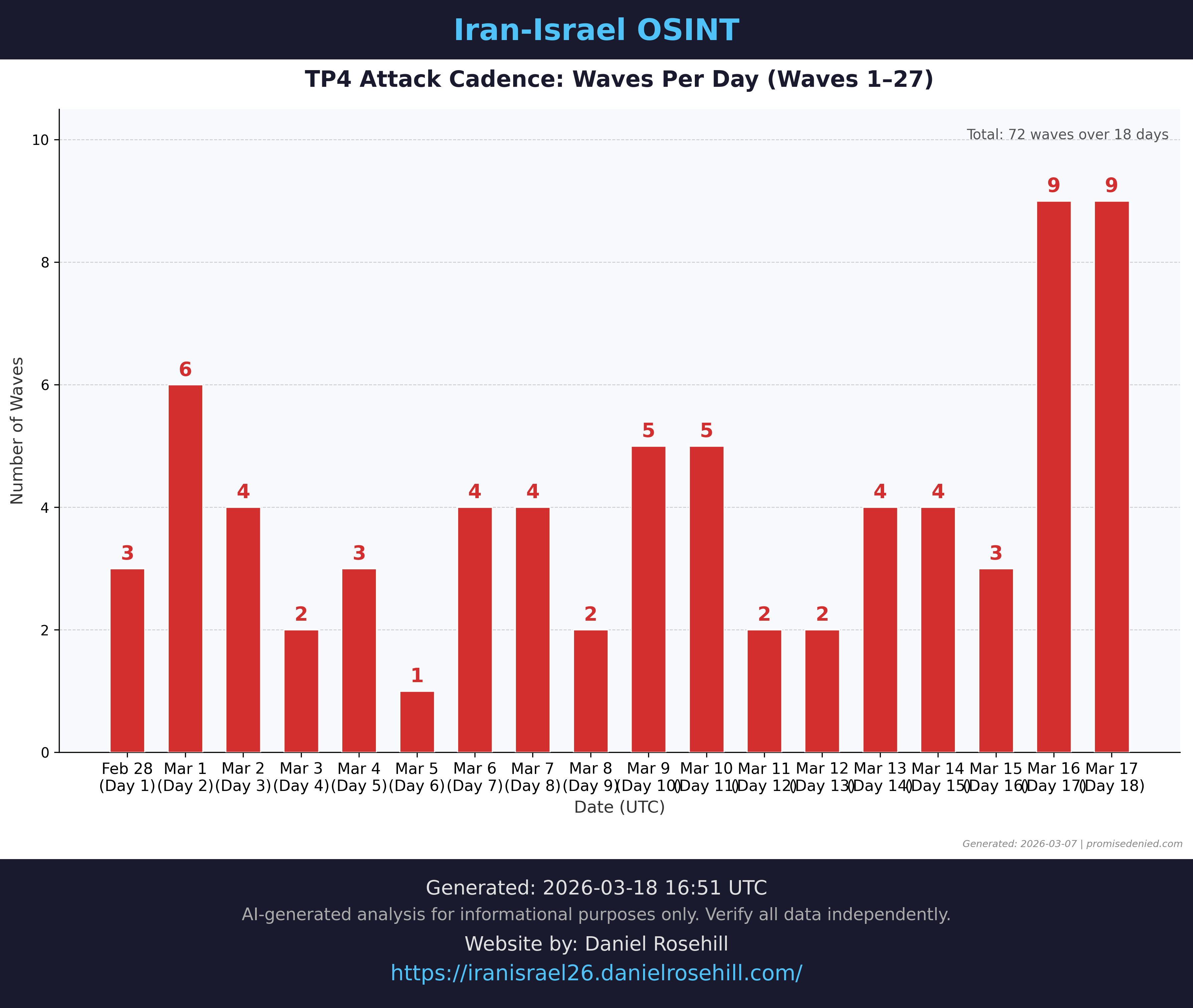
Monday — Operation True Promise 4 — Day 10 — 2 new waves (30–31)
Summary
BLUF: Day 10 of TP4 saw two attack waves (30 and 31), maintaining the reduced two-wave-per-day tempo established on Day 9 while introducing several operationally and politically significant developments. Wave 30, launched in the morning, marked the first military action under Mojtaba Khamenei's leadership following his succession as Supreme Leader on March 8, deploying Khorramshahr, Fattah hypersonic, and Kheibar Shekan ballistic missiles plus strategic drones against US and Israeli positions, triggering sirens in Netanya and Western Galilee. Wave 31 (~13:43 UTC), codename "Labbaik Ya Khamenei" ("At Your Service, Oh Khamenei"), was a joint IRGC Aerospace Force and Navy operation — the first confirmed inter-service combined wave of TP4 — deploying Qadr, Khorramshahr, and Kheibar Shekan ballistic missiles alongside loitering drones and cruise missiles against five strategic US bases (including the US Navy 5th Fleet headquarters) and Israeli military sites in Tel Aviv and Haifa. A cluster munition strike in Bat Yam dispersed 24 submunitions, killing 2 civilians in central Israel.
TP4 now stands at 31 waves across 10 days. Cumulative Israeli civilian casualties have risen to 12 killed and 2,142 injured since February 28. The leadership transition, the joint Aerospace-Navy operational format, the explicit loyalty messaging in Wave 31's codename, and the continued deployment of the Fattah hypersonic missile all indicate that Iran's campaign is intensifying politically even as wave tempo has stabilised at two per day. No ceasefire indication has been issued.
Coalition Actions
- Israeli multi-layer air defence engaged incoming ballistic and cruise missiles in both waves. Fattah hypersonic missiles in Wave 30 present an exceptionally difficult intercept problem due to Mach 13–15 terminal velocity and manoeuvrable trajectory; intercept outcomes not confirmed in open sources.
- IDF Home Front Command activated sirens in Netanya and Western Galilee during Wave 30, and across the greater Tel Aviv and Haifa metropolitan areas during Wave 31. Shelter directives issued for both waves.
- NATO air defence assets downed a second Iranian missile over Turkish airspace, following the first such intercept earlier in the campaign. This represents a continued expansion of the conflict's geographic footprint into NATO territory, with potential Article 5 implications.
- UAE air defence detected 15 ballistic missiles and 18 UAVs inbound from Iran; 12 were destroyed by Emirati and coalition defence systems, and 3 fell into the sea. This marks a significant escalation in targeting of Gulf states.
- US force protection posture at the five targeted bases in Wave 31 remains under maximum alert. The US Navy 5th Fleet headquarters in Bahrain was explicitly targeted for the first time in TP4.
- UXO clearance operations expanded to Bat Yam following the cluster munition strike in Wave 31 (24 submunitions). Ongoing clearance from prior cluster munition dispersal in Waves 20, 21, 24, 26, and 27 continued.
Iranian Actions
- Wave 30 (morning, exact time TBC): IRGC launched Khorramshahr, Fattah hypersonic, and Kheibar Shekan ballistic missiles plus strategic drones at US and Israeli positions. Sirens activated in Netanya and Western Galilee. This was the first military action since Mojtaba Khamenei became Supreme Leader on March 8, signalling immediate operational continuity under the new leadership.
- Wave 31 (~13:43 UTC / 16:43 IST), codename "Labbaik Ya Khamenei": Joint IRGC Aerospace Force and Navy operation — the first confirmed inter-service combined wave of TP4. Deployed Qadr, Khorramshahr, and Kheibar Shekan ballistic missiles alongside loitering drones and cruise missiles. Targeted five strategic US bases (including US Navy 5th Fleet headquarters in Bahrain) and Israeli military sites in Tel Aviv and Haifa.
- Cluster munition strike — Bat Yam: Wave 31 included a cluster munition warhead that dispersed 24 submunitions over the Bat Yam area in central Israel, killing 2 Israeli civilians. This is the sixth confirmed cluster munition deployment in TP4 (after Waves 20, 21, 24, 26, and 27).
- The wave codename "Labbaik Ya Khamenei" ("At Your Service, Oh Khamenei") represents a direct loyalty pledge to the new Supreme Leader, departing from the Fourteen Infallibles naming convention used in previous waves. This signals a politically motivated framing emphasising continuity and allegiance under the leadership transition.
- No ceasefire offer or end-of-operations announcement issued by Iran. State media emphasised the leadership transition as strengthening rather than disrupting the campaign.
Waves & Munitions
Wave 30 — Morning (exact time TBC)
- Weapons: Khorramshahr, Fattah (hypersonic), Kheibar Shekan ballistic missiles + strategic drones
- Targets: US and Israeli military positions (specific locations pending confirmation)
- Sirens: Netanya and Western Galilee
- Drones: Strategic drones confirmed
- Cluster munitions: Not confirmed in this wave
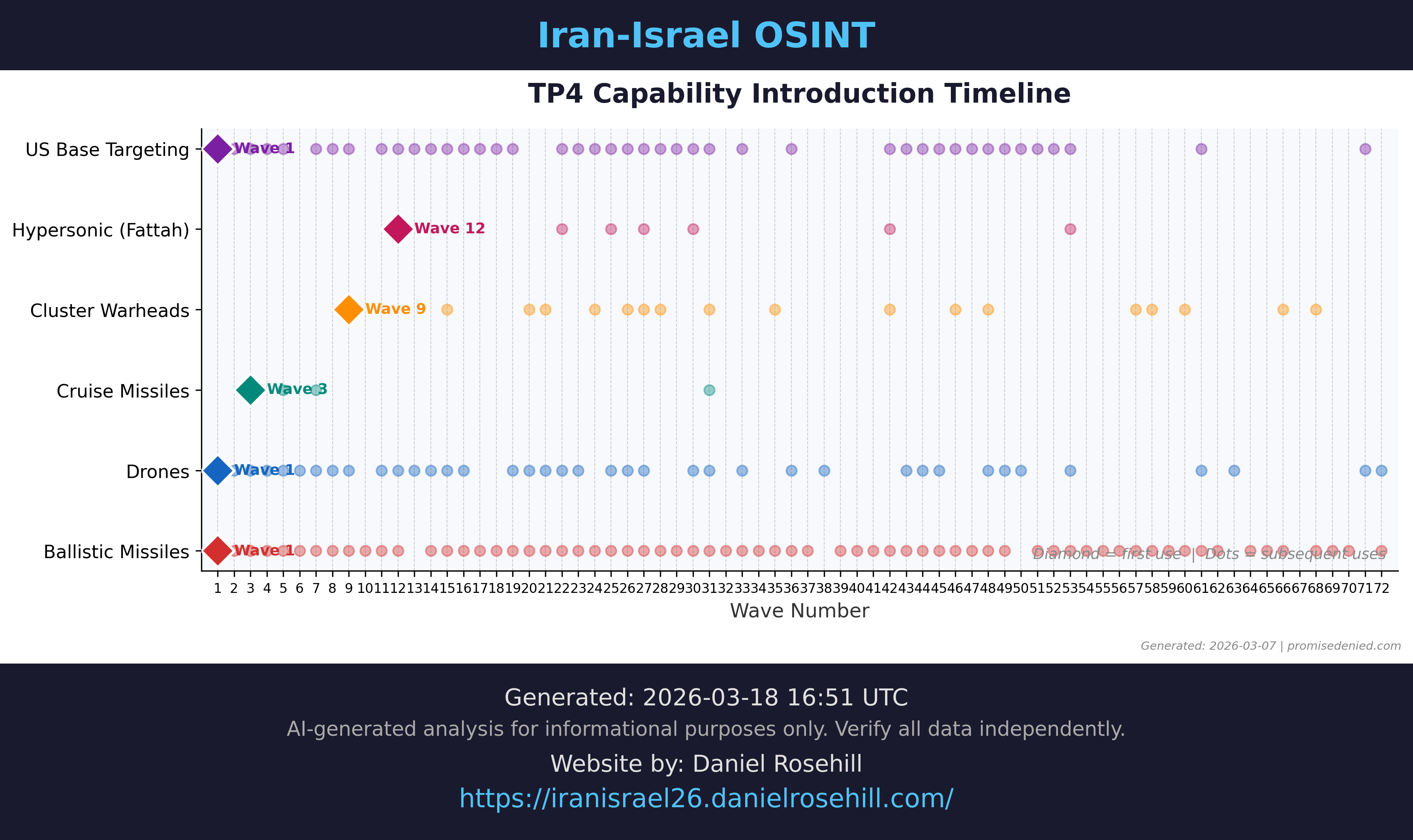
- Notable: First military action under Mojtaba Khamenei's leadership; Fattah hypersonic missile redeployed (previously seen in Wave 22)
Wave 31 — ~13:43 UTC (16:43 IST) — "Labbaik Ya Khamenei"
- Weapons: Qadr, Khorramshahr, Kheibar Shekan ballistic missiles + loitering drones + cruise missiles
- Targets: Five strategic US bases (including US Navy 5th Fleet HQ, Bahrain), Israeli military sites in Tel Aviv and Haifa
- Operation type: Joint IRGC Aerospace Force and Navy — first inter-service combined wave of TP4
- Cluster munitions: Confirmed — 24 submunitions dispersed over Bat Yam, 2 civilians killed
- Wave name significance: "Labbaik Ya Khamenei" = "At Your Service, Oh Khamenei" — direct loyalty pledge to new Supreme Leader Mojtaba Khamenei; breaks from Fourteen Infallibles naming convention
- Landings: Israel (Tel Aviv, Haifa, Bat Yam area), Bahrain (Sitra island), multiple US base locations
Tactical Assessment
- Leadership transition — no operational pause: The succession of Mojtaba Khamenei as Supreme Leader on March 8 produced zero disruption to TP4 operations. Wave 30 launched the following morning, demonstrating that either the transition was pre-planned with operational continuity built in, or that IRGC Aerospace Force command authority operates with sufficient autonomy to sustain campaign tempo independent of political transition timelines. The "Labbaik Ya Khamenei" codename in Wave 31 explicitly signals military loyalty to the new leader.
- Joint Aerospace-Navy operation — capability integration: Wave 31 marks the first confirmed inter-service combined operation of TP4, with IRGC Aerospace Force and IRGC Navy jointly deploying ballistic missiles, loitering drones, and cruise missiles. The inclusion of IRGC Navy assets expands the launch geometry, potentially complicating coalition defence by introducing maritime-origin vectors. The targeting of the US Navy 5th Fleet headquarters in Bahrain aligns with IRGC Navy mission sets.
- Fattah hypersonic redeployment: The Fattah hypersonic missile, first deployed in TP4 during Wave 22, reappeared in Wave 30. Fattah's Mach 13–15 terminal velocity and manoeuvrable glide vehicle present the most challenging intercept problem of any system in Iran's arsenal. Its continued deployment indicates sustained stockpile availability and suggests it is being used selectively rather than in saturation quantities.
- Cluster munitions — sixth wave, continued civilian toll: The Bat Yam cluster strike (24 submunitions, 2 killed) is the sixth cluster munition deployment of TP4. The targeting of a densely populated residential area in central Israel with cluster warheads continues to raise the civilian casualty toll and UXO hazard. Cumulative Israeli civilian deaths have reached 12 with 2,142 injured — the highest daily death increment since the early waves.
- Regional expansion — Bahrain directly struck: The Iranian strike on Sitra island in Bahrain, injuring 32 including children, marks a direct attack on Bahraini sovereign territory. Combined with the explicit targeting of the 5th Fleet headquarters, this represents a significant escalation in the Gulf theater. Bahrain's hosting of US naval assets has made it a target, but civilian casualties on Bahraini soil carry distinct diplomatic and humanitarian implications.
- NATO involvement deepening: A second Iranian missile downed over Turkey by NATO air defence assets deepens Turkey's entanglement in the conflict. Each intercept over Turkish airspace brings the conflict closer to formal NATO Article 5 consideration, though Turkey has historically sought to manage Iranian relations carefully.
- Houthi non-participation persists: Despite sustained rhetoric, Houthi forces remain uninvolved in TP4 combat operations as of Day 10. This contrasts with Hezbollah, which carried out 31 separate attack waves on March 8 and struck a daycare in Ramle on March 9 (16 lightly injured). The Houthi absence may reflect logistical constraints, Saudi/UAE deterrence, or deliberate Iranian sequencing.
- UAE engagement scale: The UAE's detection of 33 inbound Iranian munitions (15 BMs + 18 UAVs) with 12 destroyed and 3 falling in the sea indicates a substantial targeting effort against Emirati territory or US assets hosted there. The 18 remaining munitions that were neither destroyed nor accounted for in the sea represent an intelligence gap.
Responses & Reactions
- Israel: Air defence engaged in both waves. Two civilians killed and additional injuries in Bat Yam from cluster munitions. Sirens in Netanya, Western Galilee, Tel Aviv, and Haifa. Cumulative toll: 12 killed, 2,142 injured since Feb 28. IDF Home Front Command shelter directives issued. Daycare in Ramle struck by Hezbollah (not Iranian) attack on March 9 — 16 lightly injured.
- Bahrain: Iranian strike on Sitra island injured 32 people including children. The 5th Fleet headquarters was explicitly targeted. Bahrain has been a key US naval partner in the Gulf; direct strikes on Bahraini soil represent a major escalation. Manama has not yet issued a formal military response at time of publication.
- UAE: Detected 15 ballistic missiles and 18 UAVs inbound from Iran. 12 destroyed by air defence systems, 3 fell into the sea. Remaining munition outcomes unconfirmed. UAE force protection posture at maximum.
- Turkey / NATO: A second Iranian missile intercepted over Turkish airspace by NATO assets. Turkey remains in a difficult position between its NATO obligations and its relationship with Iran. Formal protest expected; Article 5 consultations remain a possibility if overflights continue.
- United States: Five strategic US bases targeted in Wave 31, including the 5th Fleet headquarters. CENTCOM installations across the region remain on maximum defensive alert. No public confirmation of damage or casualties at US facilities.
- Iran: IRGC framed Day 10 operations as demonstrating seamless continuity under the new Supreme Leader. State media highlighted the joint Aerospace-Navy format of Wave 31 as evidence of expanded operational capability. The "Labbaik Ya Khamenei" codename received heavy domestic coverage as a display of institutional loyalty.
- Hezbollah: Carried out 31 separate attack waves on March 8 (prior day). On March 9, a Hezbollah attack struck a daycare in Ramle, lightly injuring 16 people. Hezbollah's parallel campaign continues to extend the operational burden on Israeli air defence and home front resources.
- Houthis: Remain uninvolved in combat operations despite continued rhetoric. Their non-participation through Day 10 is increasingly notable given the escalation across all other fronts.
Data & Charts
For interactive data and visualizations, see:
- Wave Timeline — All 31 waves in reverse chronological order
- Interactive Map — Launch sites, targets, and bases
- TP4 Data Table — Searchable and exportable wave records
- Analysis Charts — Timing, weapons, targets, and escalation trends
- Daily Analysis Blog — Timestamped analysis with embedded charts
- Current Situation Dashboard — Live campaign overview
Selected charts (generated 2026-03-06, waves 1–23; updated charts pending sync):