SITREP — March 08, 2026
Sunday — Operation True Promise 4 — Day 9 — 2 new waves (28–29)
Summary
BLUF: Day 9 of TP4 saw two attack waves (28 and 29), marking a significant reduction in tempo from the preceding day's four-wave barrage, yet introducing several operationally notable developments. Most significantly, Day 9 is the first confirmed drone-free day of the entire TP4 campaign — no drone strikes were recorded in either wave. Whether this reflects deliberate operational restraint, platform reallocation, or sustained attrition of Iran's UAV stockpile remains unconfirmed. Wave 28 (10:30 UTC) deployed MARV-equipped ballistic missiles (Qadr, Emad, and Kheibar Shekan) against Tel Aviv, Be'er Sheva, and — for the first time since Day 1 — Al-Azraq Air Base in Jordan, re-opening the Jordanian theater. Wave 29 (15:30 UTC), codename "Ya Ali Ibn Abi Talib," deployed a self-described "new generation of missiles" against Tel Aviv, the Negev, and an unspecified US air base, completing a near-full cycle through the Fourteen Infallibles in wave naming. TP4 now stands at 29 waves across 9 days, with cumulative estimated totals of 950–1,000 ballistic missiles and 2,150+ drones.
The longest inter-wave gap of the campaign — 15.75 hours between Wave 27 (18:30 UTC, Mar 7) and Wave 28 (10:30 UTC, Mar 8) — preceded today's opening salvo, suggesting either an extended operational pause for reconstitution or a deliberate pacing choice. Despite reduced tempo, missile capability continued to escalate: MARV-equipped reentry vehicles and an unspecified new missile generation both featured on Day 9, sustaining the qualitative escalation trajectory of preceding days.
Coalition Actions
- Israeli multi-layer air defence engaged incoming ballistic missiles in both waves. MARV-equipped reentry vehicles in Wave 28 present a substantially harder intercept problem than standard ballistic trajectories due to in-flight manoeuvring; intercept outcomes not confirmed in open sources.
- IDF Home Front Command issued shelter directives for Wave 28 (Tel Aviv and Be'er Sheva corridors) and Wave 29 (Tel Aviv and Negev region). All-clear timing not confirmed at time of publication.
- Jordan's air defence activated in response to Wave 28 targeting of Al-Azraq Air Base. Al-Azraq hosts Jordanian Royal Air Force F-16s and serves as a regional ISR hub; intercept and damage assessment pending open-source confirmation.
- US force protection posture at the unspecified US air base targeted in Wave 29 remains unknown. CENTCOM has not publicly confirmed which installation was targeted.
- UXO clearance operations from cluster munition dispersal in Waves 20, 21, 24, 26, and 27 continued across Israeli population centres. No new cluster munition use confirmed on Day 9.
- Ben Gurion Airport and Haifa industrial zone, targeted in prior waves, remained under heightened security protocols; no new strikes on these facilities confirmed today.
Iranian Actions
- Wave 28 (10:30 UTC / 12:30 IST): Qadr, Emad, and Kheibar Shekan ballistic missiles, all equipped with MARV (Manoeuvrable Reentry Vehicle) technology. Targets: Tel Aviv, Be'er Sheva (Israel), and Al-Azraq Air Base (Jordan). IRGC announced the wave at approximately 11:22 UTC via @MilitaryObs2222. No drones employed. Jordan targeted for the first time since Day 1 of TP4 (Feb 28).
- Wave 29 (15:30 UTC / 17:30 IST), codename "Ya Ali Ibn Abi Talib": Self-described "new generation of missiles" — specific type unspecified in open-source reporting. Ballistic missiles confirmed; cruise missile and drone employment status unknown. Targets: Tel Aviv, the Negev region (Israel), and an unspecified US air base. IRGC announced at approximately 16:00 UTC via @AbebeSamson1.
- No drone waves were launched on Day 9 — the first drone-free day across all 9 days of TP4. Whether this reflects deliberate operational choice, stockpile constraint, or temporary platform reallocation is not determinable from available open-source data.
- The wave name "Ya Ali Ibn Abi Talib" invokes Ali ibn Abi Talib, the first Shia Imam and son-in-law of the Prophet Muhammad, completing a near-full cycle through the Fourteen Infallibles in TP4 wave naming. This naming pattern has been consistent throughout the operation, reflecting the religious-political framing of Iran's campaign.
- No ceasefire offer or end-of-operations announcement issued by Iran. State media coverage continued throughout the day.
Waves & Munitions
Wave 28 — 10:30 UTC (12:30 IST)
- Weapons: Qadr, Emad, and Kheibar Shekan ballistic missiles, all MARV-equipped
- Targets: Tel Aviv (Israel), Be'er Sheva (Israel), Al-Azraq Air Base (Jordan)
- MARV technology: Confirmed — all three missile types in this wave carry manoeuvrable reentry vehicles
- Drones: None
- Cluster munitions: Not confirmed
- Announced: ~11:22 UTC by IRGC; source @MilitaryObs2222
- Notable: Jordan targeted for first time since Day 1 (Feb 28); longest pre-wave pause (15.75 hrs since Wave 27)
- Landings: Israel, Jordan
Wave 29 — 15:30 UTC (17:30 IST) — "Ya Ali Ibn Abi Talib"
- Weapons: "New generation of missiles" per IRGC — specific type unspecified; ballistic missiles confirmed; cruise and drone status unknown
- Targets: Tel Aviv (Israel), the Negev region (Israel), unspecified US air base
- Drones: Unknown / not confirmed in open sources
- Cluster munitions: Not confirmed
- Announced: ~16:00 UTC by IRGC; source @AbebeSamson1
- Wave name significance: Ali ibn Abi Talib is the first of the Fourteen Infallibles in Shia Islam — this naming completes a near-full cycle through the Infallibles across TP4 wave codenames
- Landings: Israel, unspecified US base (country unknown)
Tactical Assessment
- Drone-free day — three interpretations: The complete absence of drone strikes on Day 9 is the first such occurrence in TP4. Three explanations are plausible: (1) deliberate operational shift to an all-ballistic posture to reduce warning times and saturate defences differently; (2) temporary platform stand-down for maintenance, reloading, or tactical repositioning; or (3) progressive UAV stockpile depletion after 8 days of sustained multi-drone-wave operations. Available open-source data cannot distinguish between these hypotheses with confidence.
- MARV deployment in Wave 28: The confirmed use of Manoeuvrable Reentry Vehicles across all three missile types in Wave 28 (Qadr, Emad, Kheibar Shekan) marks a qualitative step beyond standard ballistic trajectories. MARV-equipped missiles can adjust their flight path during terminal descent, degrading the effectiveness of point-defence intercept solutions that rely on predictable ballistic arcs. This capability was observed in the Kheibar Shekan previously but its extension to the Qadr and Emad variants represents a broader fielding of the technology.
- Jordan re-targeted: Al-Azraq Air Base hosts Jordanian F-16s and serves as a hub for regional ISR operations, including assets that may have supported coalition tracking of Iranian launches. Its re-targeting after a 7-day gap since Day 1 suggests Iran has not abandoned the Jordanian theater and may be responding to perceived Jordanian support for coalition air defence operations. Jordan's interception of Iranian missiles during TP1 (April 2024) is a documented precedent Iran has not forgotten.
- Al-Azraq as a strike enabler target: Framing today's Jordanian strike as targeting "strike enablers" is analytically sound — ISR assets at Al-Azraq provide real-time launch detection and tracking data that contributes to intercept solutions. Degrading this infrastructure would reduce coalition lead time for engagement.
- Geographic narrowing: Day 9 targeted only 2 countries — Israel and Jordan — the narrowest geographic spread of any day in TP4. This may reflect prioritisation of high-value targets over broad-front geographic signaling, or simply reduced launch capacity relative to prior days. Previous days with the widest geographic spread (Day 7-8: UAE, Kuwait, Iraq, Saudi Arabia, Jordan, Cyprus, etc.) may represent a peak that is now contracting.
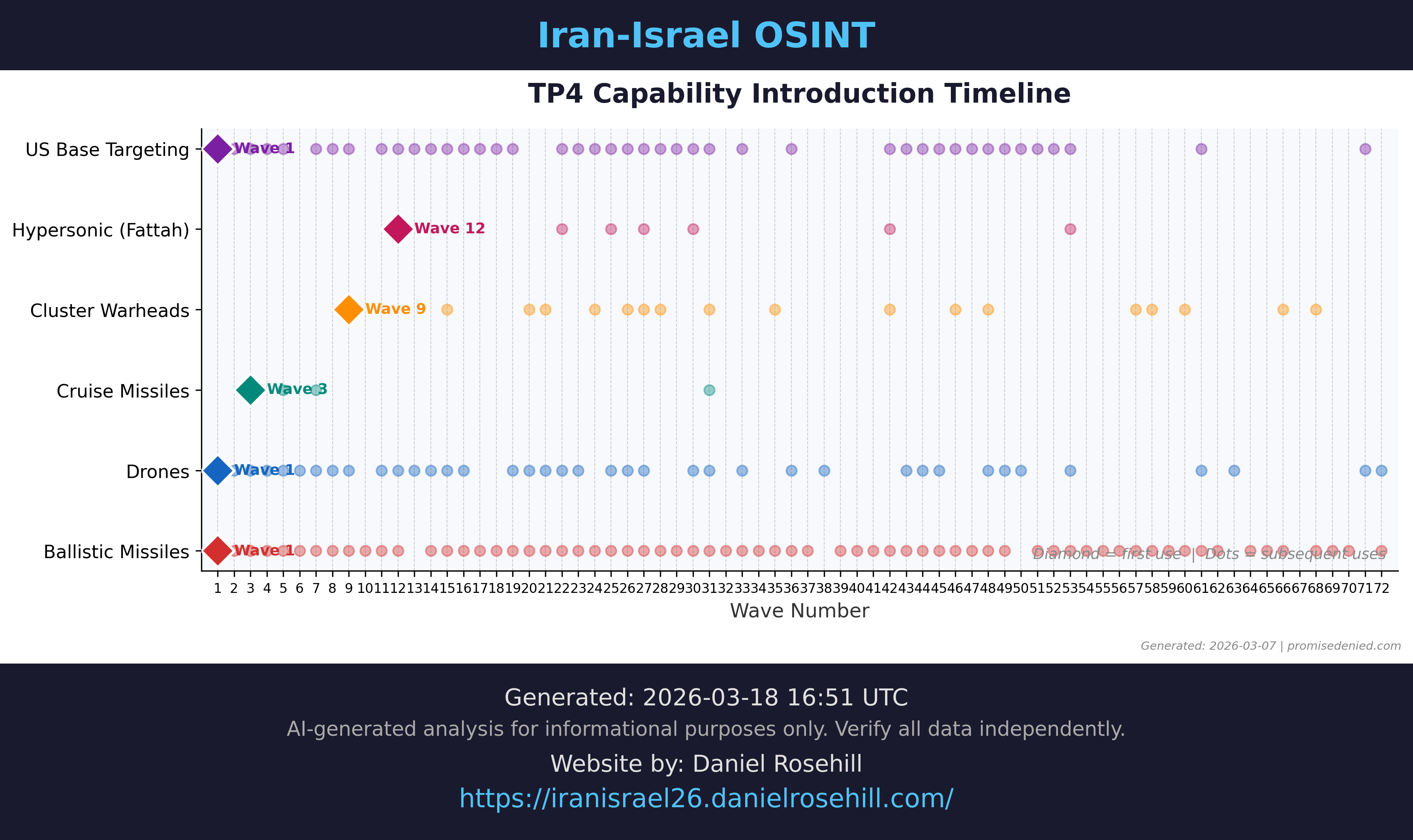
- "New generation of missiles" in Wave 29: Iran's characterisation of Wave 29 munitions as a new generation, without specifying the system, is consistent with its established practice of announcing new capabilities mid-campaign (Fattah in Wave 22, Fattah-2 in Wave 27, Khorramshahr-4 in Wave 22). If accurate, this represents a tenth distinct missile system introduced during TP4, sustaining the qualitative escalation trajectory.
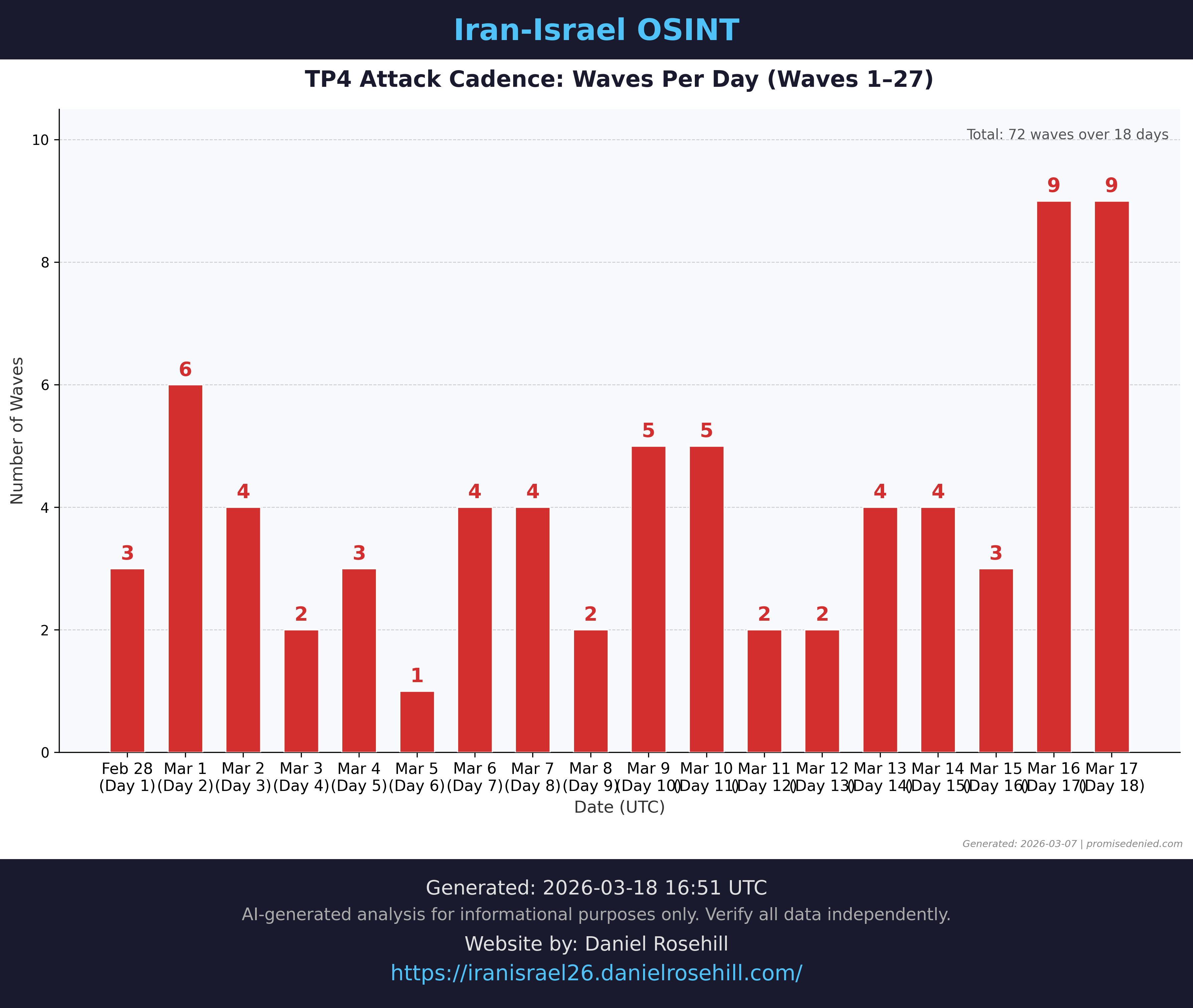
- Campaign duration — nine days: At 29 waves over 9 days, TP4 has already exceeded TP3 (22 waves, 12 days) in wave volume while compressing the timeline. No Iranian statement indicating end-of-operations has been issued. The transition from 4 waves (Day 8) to 2 waves (Day 9) may indicate operational consolidation, but historical pattern within TP4 shows tempo has varied significantly from day to day without presaging cessation.
- Proxy forces: Hezbollah, Iran-aligned Iraqi militias, and Houthi forces activated from Day 8 continue to apply pressure on additional fronts, extending the operational load on coalition air defence assets beyond what the wave count alone indicates.
Responses & Reactions
- Israel: Air defence activated in both waves. MARV-equipped missiles in Wave 28 represent a harder intercept geometry than standard ballistic trajectories; intercept success rates not confirmed in open sources. IDF Home Front Command shelter warnings issued. Ongoing UXO clearance from prior cluster munition waves continued unabated.
- Jordan: Al-Azraq Air Base targeted by Wave 28 — Jordanian Royal Air Force air defence activated. Jordan has previously shot down Iranian ballistic missiles and drones in transit (April 2024) and is a de facto coalition partner in theatre air defence. A direct strike on Jordanian military infrastructure carries significant escalation implications for the coalition's regional architecture. Official Jordanian government statement pending at time of publication.
- United States: Wave 29 explicitly targeted an unspecified US air base. CENTCOM installations across the region remain on maximum defensive alert following direct strikes on Al-Dhafra (UAE), Al-Minhad (UAE), Camp Udairi (Kuwait), and Camp Buehring (Kuwait) in prior days. The undisclosed nature of the target complicates open-source damage assessment.
- Iran: IRGC issued announcements for both waves. Framing consistent with prior days: targeting of US-Israeli military infrastructure, demonstration of advanced missile capability. The "new generation" characterisation in Wave 29 continues Iran's pattern of using mid-campaign capability announcements for strategic signaling. No ceasefire indication.
- International community: Sustained diplomatic pressure on both parties from UN, EU, and Arab League member states. Jordan's re-targeting is expected to provoke formal protest from Amman and potentially from GCC states that have maintained formal neutrality. The absence of drone strikes today may provide limited respite for civil aviation monitoring agencies, though ballistic missile launches remain a persistent threat to regional airspace.
- Gulf states: UAE and Kuwait, directly struck on Day 7 and Day 8, have not yet publicly confirmed details of damage at targeted US bases. Saudi Arabia and Qatar continue to host US forward assets; neither has been directly struck in TP4, though CENTCOM installations across the Gulf remain within Iran's declared target set.
Data & Charts
For interactive data and visualizations, see:
- Wave Timeline — All 29 waves in reverse chronological order
- Interactive Map — Launch sites, targets, and bases
- TP4 Data Table — Searchable and exportable wave records
- Analysis Charts — Timing, weapons, targets, and escalation trends
- Daily Analysis Blog — Timestamped analysis with embedded charts
- Current Situation Dashboard — Live campaign overview
Selected charts (generated 2026-03-06, waves 1–23; updated charts pending sync):