SITREP — March 11, 2026
Wednesday — Operation True Promise 4 — Day 12 — 2 new waves (40–41) — 41 total
Summary
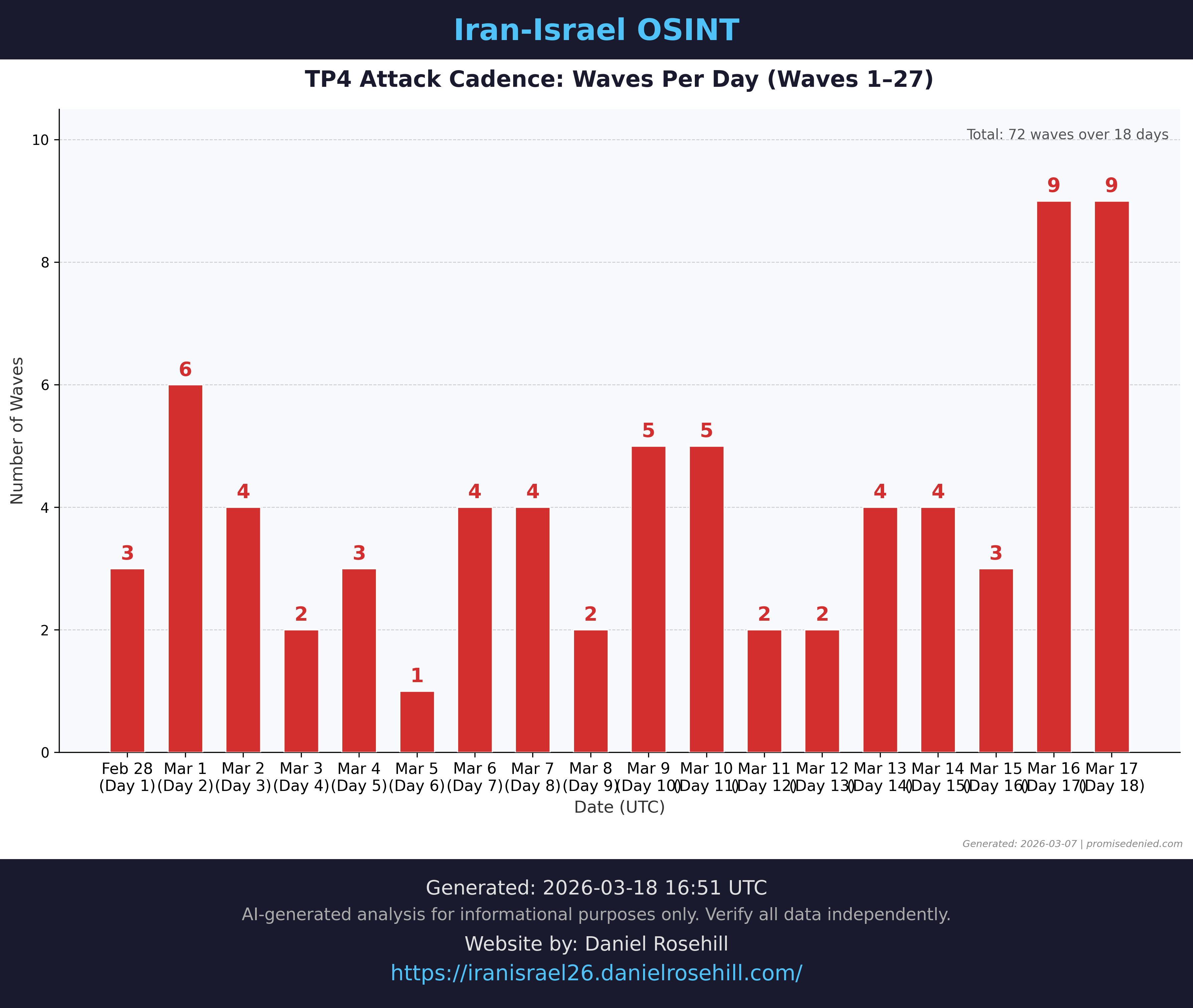
BLUF: Day 12 of TP4 saw two attack waves (40 and 41), the lowest daily wave count of the entire campaign and a stark contrast to the 5–8 wave days in the first week. Iran's fire rate has declined approximately 92% from Day 1 peak, consistent with coalition claims that over 60% of Iranian missile launchers have been destroyed in ongoing US-Israeli strikes on Iranian territory. Wave 40, an overnight salvo at 00:51 IST, was intercepted or impacted open areas with no casualties. Wave 41, an afternoon ballistic missile salvo at 13:45 IST after a nine-hour pause, deployed heavy multi-warhead projectiles against central and northern Israel, with at least one missile reportedly reaching the Tel Aviv area.
Diplomatically, Iran's Foreign Minister rejected ceasefire calls on March 10–11, signalling continued Iranian commitment to the campaign despite sharply reduced capability. The Houthis have not joined TP4 combat operations despite widespread expectations and rhetoric. TP4 now stands at 41 waves across 12 days. Cumulative Israeli civilian casualties remain at 14 killed and 2,339 wounded since February 28. Cumulative munitions estimates: approximately 2,410 ballistic missiles and 3,560 drones fired across all targets.
Coalition Actions
- Israeli multi-layer air defence (Arrow-2, Arrow-3, David's Sling) engaged incoming ballistic missiles in both waves. Wave 40 was fully intercepted or allowed to impact open areas with no injuries confirmed by IDF at 01:30 IST. Wave 41 interceptions observed over Israel, though at least one missile reportedly reached the Tel Aviv area.
- IDF Home Front Command activated sirens across central Israel, Jerusalem, northern Israel, and parts of the West Bank during Wave 40. Central and northern Israel sirens activated during Wave 41.
- Coalition strikes on Iranian launcher infrastructure continued. Open-source estimates now indicate over 60% of Iranian missile launchers destroyed, contributing to the dramatic reduction in daily wave count from 5–8 in the first week to just 2 on Day 12.
- IDF confirmed no injuries or direct impacts on populated areas from Wave 40. Damage assessment for Wave 41 remains pending.
Iranian Actions
- Wave 40 (00:51 IST / 22:51 UTC Mar 10): Small number of ballistic missiles launched at Israel targeting central Israel, Jerusalem area, and northern Israel. Missiles were intercepted or impacted open areas. IDF confirmed no injuries. Consistent with IRGC's announced shift to heavier warheads (1+ ton) with reduced salvo frequency.
- Wave 41 (13:45 IST / 11:45 UTC Mar 11): After a nine-hour operational pause — one of the longest of TP4 — IRGC launched a fresh ballistic missile salvo with heavy, multi-warhead projectiles at central and northern Israel. Al Jazeera reported interceptions observed over Israel. At least one missile reportedly reached the Tel Aviv area. Damage assessment pending.
- Ceasefire rejected: Iran's Foreign Minister rejected international ceasefire calls on March 10–11, declaring that Iran's campaign would continue. This removes any near-term diplomatic off-ramp and signals that TP4 will persist despite degraded launch capacity.
- Reduced tempo: Only 2 waves on Day 12 compared to 5 waves on Day 11 (waves 35–39) and the 5–8 wave peak days. The 92% decline from Day 1 fire rate strongly suggests attrition of launch infrastructure rather than a deliberate operational pause.
- No Houthi participation in TP4 operations as of Day 12, despite sustained rhetoric from Ansar Allah leadership and widespread analyst expectations of their entry.
Waves & Munitions
Wave 40 — 00:51 IST (22:51 UTC Mar 10) — Overnight
- Weapons: Small number of ballistic missiles (specific types pending confirmation)
- Targets: Central Israel, Jerusalem area, northern Israel. Sirens in central Israel, Jerusalem, northern Israel, and parts of the West Bank.
- Duration: ~40 minutes
- Outcome: Missiles intercepted or impacted open areas. IDF confirmed no injuries or direct impacts on populated areas.
- Notable: Consistent with IRGC's announced shift to heavier warheads (1+ ton) at reduced salvo frequency.
Wave 41 — 13:45 IST (11:45 UTC Mar 11) — Afternoon
- Weapons: Ballistic missiles with heavy, multi-warhead projectiles
- Targets: Central Israel and northern Israel. Sirens in central and northern Israel.
- 9-hour pause: Longest gap between salvos of the day; one of the longest operational pauses of the entire campaign.
- Outcome: Interceptions observed over Israel. At least one missile reportedly reached the Tel Aviv area. Full damage assessment pending.
- Sources: Times of Israel liveblog, Al Jazeera live coverage
Day 11 Recap (March 10) — 5 Waves
Note: No SITREP was published for March 10. The following summarises Day 11 (waves 35–39) for continuity.
- Wave 35 (overnight): IRGC cluster warhead strike on central Israel — submunitions across six sites in Yehud, Or Yehuda, Holon, Bat Yam, Rishon Letzion. 2 construction workers killed at Yehud site (Rustam Gulomov and Amid Murtuzov). 3 wounded including 1 moderately in Rishon Letzion. IRIB hailed it as "first wave under Mojtaba Khamenei." Emad, Ghadr, Kheibar Shekan, Fattah confirmed.
- Wave 36 (overnight): 17 BMs and 6 drones targeting Qatar (likely Al Udeid Air Base). Qatar Armed Forces intercepted all 23 projectiles. Zero casualties. Qatar MoD released interception video.
- Wave 37 (morning): Ballistic missiles targeting Jerusalem and Beit Shemesh. Sirens across Jerusalem, West Bank, southern Israel. Reports of impacts near Beit Shemesh. No injuries initially reported. Ghadr, Kheibar Shekan, Khorramshahr-4 confirmed. Concurrent with Hezbollah rocket fire on Haifa Bay.
- Wave 38 (morning): Iranian Army (not IRGC) announced drone attack targeting Haifa oil and gas refinery and fuel tanks. First confirmed targeting of Israeli energy infrastructure by the regular Iranian Army in TP4. Shahed-136 confirmed.
- Wave 39 (evening): Fifth salvo of Day 11. Ballistic missile(s) targeting central Israel. One missile struck open area near Beit Shemesh. No injuries.
Tactical Assessment
- Attrition is dominating the campaign: The decline from 5–8 waves per day in the first week to just 2 on Day 12 represents a 92% reduction in fire rate from Day 1. With over 60% of Iranian launchers reportedly destroyed by coalition strikes, this trajectory suggests Iran's operational capacity is being degraded faster than it can reconstitute. The nine-hour pause between waves 40 and 41 — one of the longest in TP4 — may reflect logistical constraints rather than deliberate timing.
- Shift to quality over quantity: IRGC's announced transition to heavier warheads (1+ ton) with reduced salvo frequency may be partly operational doctrine and partly forced adaptation to launcher attrition. Multi-warhead projectiles in Wave 41 represent an attempt to maximise impact per launch when launch opportunities are increasingly scarce.
- Diplomatic off-ramp closed: Iran's Foreign Minister's rejection of ceasefire calls on March 10–11 eliminates any near-term negotiated pause. This decision is notable given the campaign's diminishing returns: Day 12 produced zero confirmed casualties while Iran continues to expend irreplaceable strategic assets. The decision to persist suggests political factors (Mojtaba Khamenei's need to demonstrate resolve in his first week as Supreme Leader) outweigh military cost-benefit analysis.
- Houthi non-participation increasingly significant: Twelve days into TP4 with no Houthi combat entry is now a defining feature of this round. Unlike TP3 where proxy coordination was tighter, TP4's multi-front strategy depends on Iran alone (with Hezbollah operating a parallel but separate campaign). The Houthis' absence reduces the operational burden on coalition air defence and removes a key southern threat axis that was anticipated.
- Day 11 (recap) showed residual capability: Five waves on March 10, including a lethal cluster strike (Wave 35, 2 killed), a 23-munition Qatar salvo (Wave 36), Jerusalem targeting (Wave 37), energy infrastructure targeting (Wave 38), and a fifth evening salvo (Wave 39), demonstrate that Iran retains meaningful capability even under attrition. However, the drop from 5 to 2 waves the following day accelerates the decline trend.
- Regular Iranian Army involvement: Wave 38's drone attack on Haifa refinery was attributed to the Iranian Army (Artesh) rather than the IRGC. This marks a widening of institutional participation in TP4 beyond the IRGC Aerospace Force and Navy, possibly to distribute the launch burden across surviving platforms.
- Casualty trend flattening: Cumulative Israeli casualties (14 killed, 2,339 wounded) have been relatively stable over the last 48 hours. The last confirmed fatalities were in Wave 35 (Day 11 overnight). Reduced wave tempo and effective air defence are compressing Iran's ability to inflict mass casualties, though the Tel Aviv impact in Wave 41 awaits full assessment.
Responses & Reactions
- Israel: Air defence fully engaged in both waves. No confirmed casualties on Day 12. Cumulative toll remains at 14 killed, 2,339 wounded since Feb 28. Shelter directives issued for central Israel, Jerusalem, northern Israel, and West Bank. Wave 41 impact assessment in Tel Aviv area pending.
- Iran: Foreign Minister rejected international ceasefire calls on March 10–11, stating the campaign would continue. IRGC announced doctrinal shift to heavier warheads (1+ ton) at reduced frequency. State media framing emphasises "continued resistance" under new Supreme Leader Mojtaba Khamenei rather than acknowledging launcher attrition.
- United States: Coalition counter-force operations against Iranian launcher infrastructure continuing. Over 60% launcher destruction rate (coalition estimate) directly correlates with reduced Iranian fire rate. CENTCOM installations remain on maximum defensive alert following Day 11's 5th Fleet targeting.
- Qatar: Successful interception of all 23 Iranian munitions in Wave 36 (Day 11) demonstrated robust Qatari air defence capability. Qatar MoD publicly released interception footage, an unusual step signalling confidence and solidarity with the coalition.
- Houthis: Remain uninvolved in combat operations through Day 12 despite continued rhetoric. Their sustained absence is now a significant strategic factor reducing Iran's multi-front pressure on coalition defences.
- Hezbollah: Continues parallel operations separately from Iranian waves, with rocket fire on Haifa Bay area concurrent with Day 11 waves. Hezbollah's campaign extends the operational burden on Israeli home front resources independently of Iranian launch tempo.
Data & Charts
For interactive data and visualizations, see:
- Wave Timeline — All 41 waves in reverse chronological order
- Interactive Map — Launch sites, targets, and bases
- TP4 Data Table — Searchable and exportable wave records
- Analysis Charts — Timing, weapons, targets, and escalation trends
- Daily Analysis Blog — Timestamped analysis with embedded charts
- Current Situation Dashboard — Live campaign overview
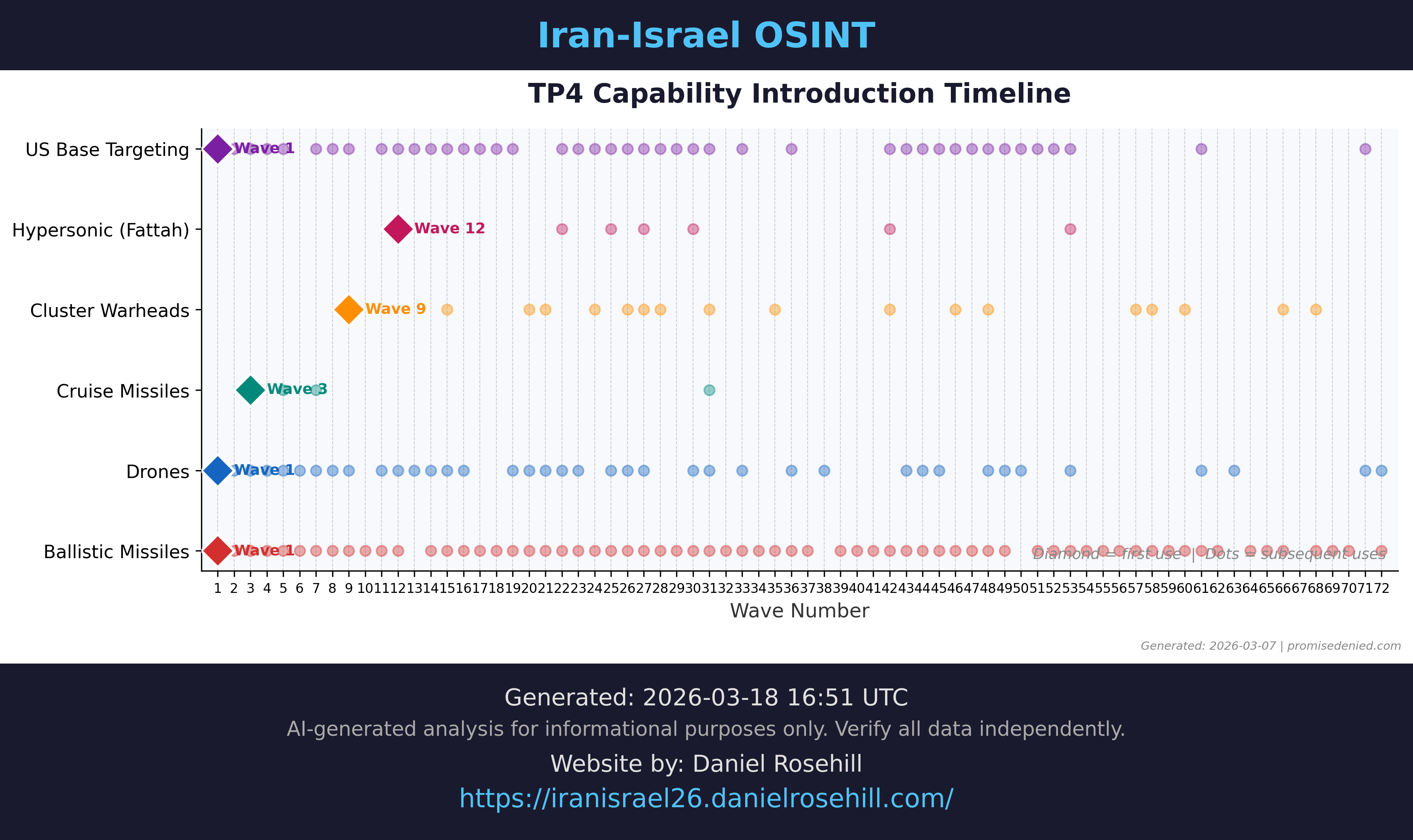
Selected charts (generated 2026-03-06, waves 1–23; updated charts pending sync):