Shahed-136
Iran's signature one-way attack drone — a low-cost loitering munition designed for mass production and saturation tactics, widely proliferated to Russia, Houthis, and Hezbollah.
Reference data current as of March 2026.
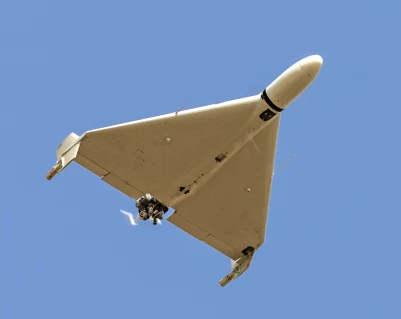
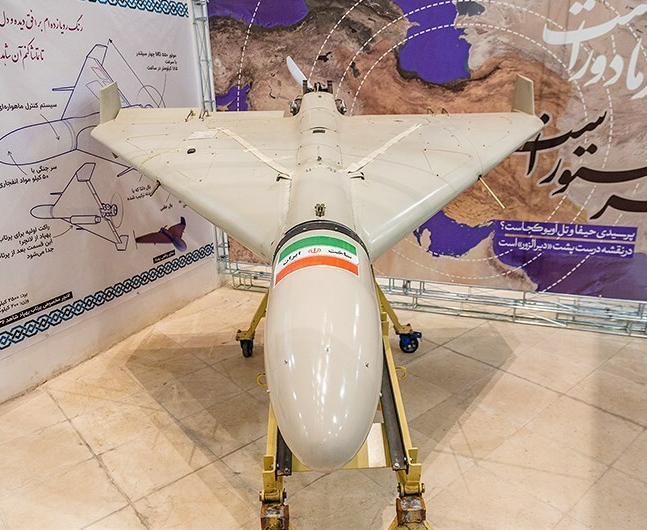
The Shahed-136 is the defining weapon of Iran's asymmetric strategy — a delta-wing, pusher-propeller one-way attack drone built for mass production at approximately $20,000 per unit. Its strategic value lies not in individual lethality (the 50 kg warhead is modest) but in the cost-exchange ratio it imposes on defenders: a $20K drone forces the expenditure of interceptors costing $50K to $36M each. Launched in salvos from truck-mounted multi-rail RATO (rocket-assisted takeoff) launchers, the Shahed-136 is designed to saturate air defences through sheer volume. It uses civilian GNSS with pre-programmed waypoints for navigation, making it highly vulnerable to GPS jamming — a weakness defenders have exploited. Known as "Geran-2" in Russian service, it has been widely proliferated to Russia (for use in Ukraine), the Houthis, and Hezbollah.
- Extremely low unit cost (~$20K) enables mass saturation tactics
- Delta-wing configuration with pusher propeller — simple, mass-producible design
- Widely proliferated to Russia (Geran-2), Houthis, and Hezbollah
- Slow speed (~185 km/h) but complicates cost-exchange ratio for defenders
- Civilian GNSS navigation is highly vulnerable to GPS jamming
- RATO truck launcher can fire multiple drones in rapid sequence
First used in the September 2019 Abqaiq-Khurais attack on Saudi oil facilities, the Shahed-136 gained global recognition from September 2022 onwards through massive Russian use against Ukrainian infrastructure. In the Iran-Israel conflict, it has been a staple of every True Promise operation, typically fired in large salvos to saturate Israeli air defences ahead of ballistic missile strikes. Its slow speed (it takes hours to reach Israel from Iranian territory) actually serves as a timing tool — drones are launched well before faster ballistic missiles, timed to arrive simultaneously and overwhelm defences.
AI-generated content for informational purposes only. Data should be independently verified against primary sources.