Ghadr
A family of Shahab-3 derivative MRBMs with stretched fuel tanks and improved guidance, fielded in multiple variants covering 1,350 to 1,950 km range.
Reference data current as of March 2026.
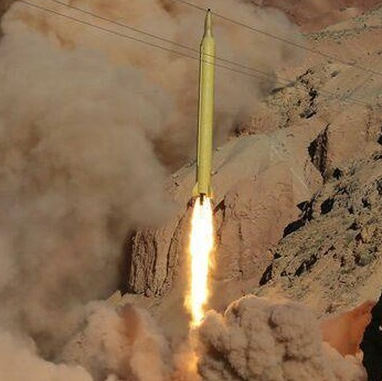
The Ghadr family represents an incremental improvement over the baseline Shahab-3, achieved primarily through stretched fuel tanks that extend range and a distinctive "baby bottle" reentry vehicle nose cone. Multiple variants exist — Qadr S, Qadr H, and Qadr F — offering progressively longer ranges. The system uses strap-down inertial navigation with GPS/GLONASS midcourse corrections, achieving a CEP of approximately 300 m. Its MaRV capability allows limited terminal manoeuvring. First operational around 2007, the Ghadr has been a mainstay of IRGC Aerospace Force inventory for nearly two decades.
- Distinctive "baby bottle" reentry vehicle nose cone
- 30-minute setup time — faster than the original Shahab-3
- Road-mobile on wheeled TEL for rapid dispersal and survivability
- GPS/GLONASS midcourse correction, vulnerable to GNSS denial
- Multiple variants allow range optimisation for different target sets
The Ghadr's first confirmed combat use was in June 2025 during True Promise 3, where it was employed alongside other Shahab-3 derivatives and newer solid-fuel systems in massed salvo attacks against Israel. As a liquid-fuel missile, it requires longer launch preparation than solid-fuel alternatives like the Kheibar Shekan, making it more vulnerable to pre-emptive strike during fuelling.
AI-generated content for informational purposes only. Data should be independently verified against primary sources.