Fattah-1 / Fattah-2
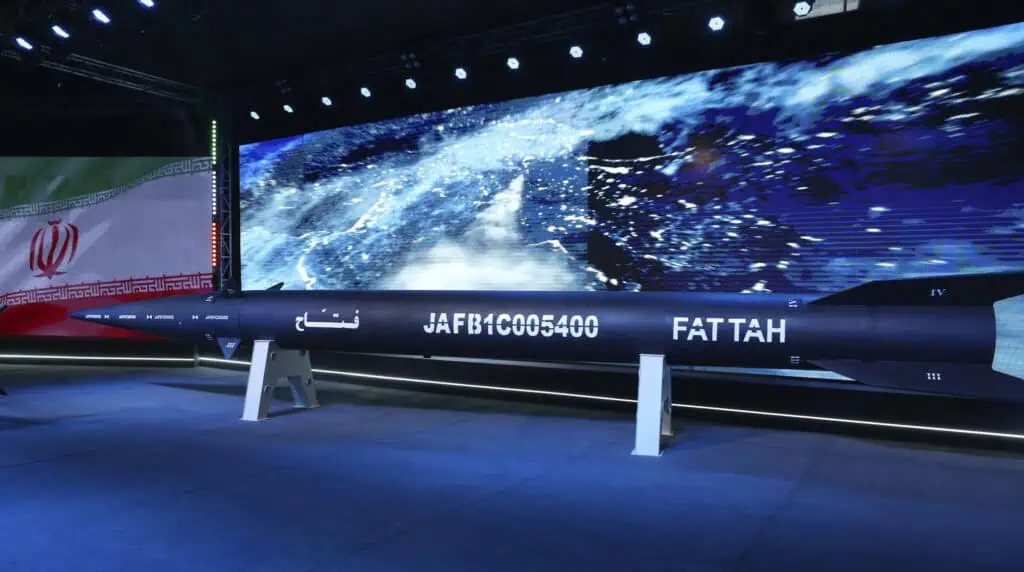
Iran's most advanced strike weapons: the Fattah-1 MaRV-equipped MRBM and the Fattah-2, Iran's first true hypersonic glide vehicle system.
Reference data current as of March 2026.
The Fattah-1 ("Conqueror") is Iran's most advanced MaRV-equipped MRBM. Its defining feature is a thrust vector control (TVC) system using a moveable nozzle, allowing the MaRV to perform evasive manoeuvres up to 100 km before impact. Iran claims it is "hypersonic," sustaining speeds above Mach 5 in the terminal phase — however, the IISS and Western analysts classify it as a MaRV-MRBM rather than a true hypersonic weapon, since it lacks a glide vehicle. If the claimed CEP of 10–25 m is accurate, it would be the most precise missile in Iran's MRBM inventory. The second-stage sustainer is based on the Arash-24 design.
The Fattah-2 is Iran's first true hypersonic glide vehicle weapon system — a genuine HGV second stage that sustains Mach 5+ glide with lateral manoeuvring in pitch and yaw throughout the glide phase. Unlike the Fattah-1 (which achieves hypersonic speeds only through ballistic terminal velocity), Western analysts assess the Fattah-2 as a legitimate HGV system. Its unpredictable approach vector makes it significantly harder to intercept than conventional ballistic trajectories. The trade-off is a smaller warhead (200 kg vs 500 kg) due to HGV mass constraints. Iran claims Mach 15, which remains unverified.
- Fattah-1: MaRV capable of evasive manoeuvres up to 100 km before impact via TVC
- Fattah-2: True HGV with unpredictable glide trajectory — first Iranian weapon in this class
- Both use solid-fuel propulsion for rapid launch preparation
- Fattah-2 trades warhead mass (200 kg vs 500 kg) for HGV manoeuvrability
- Most expensive weapons in Iranian ballistic missile inventory
The Fattah-1 saw its first combat use in June 2025 during True Promise 3. The Fattah-2 was first used in combat on 1 March 2026 during True Promise 4, marking the first confirmed use of a hypersonic glide vehicle in the Iran-Israel conflict. The Fattah-2's HGV trajectory complicates interception by existing BMD systems, which are designed primarily for ballistic flight profiles.
AI-generated content for informational purposes only. Data should be independently verified against primary sources.