Emad
Iran's first precision-guided medium-range ballistic missile: a Shahab-3 derivative equipped with a maneuverable reentry vehicle (MaRV) for terminal-phase trajectory correction.
Reference data current as of March 2026.
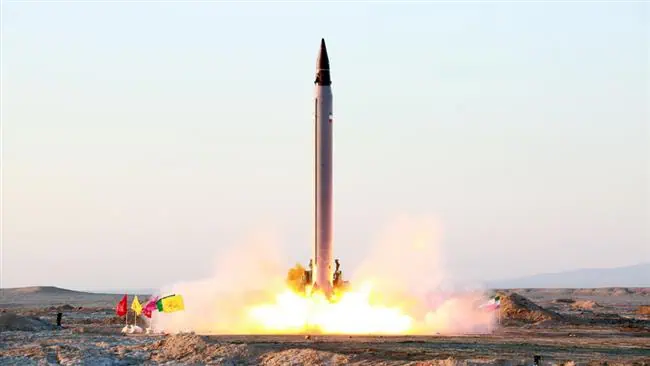
The Emad is a direct derivative of the Shahab-3, Iran's workhorse liquid-fuel MRBM. Its principal advance is a redesigned nose cone housing a fin-guided maneuverable reentry vehicle (MaRV) that allows trajectory adjustment during terminal flight. While still relatively inaccurate by modern standards (CEP ~500 m), it represented a significant step for Iran's missile programme when unveiled in 2015 — making it the first Iranian MRBM with any form of precision guidance. The missile uses GNSS-aided corrections (GPS/GLONASS/BeiDou) during midcourse flight, though it remains susceptible to jamming.
- Iran's first precision-guided MRBM — marked a generational shift from unguided Shahab-3
- Fin-guided MaRV reentry vehicle enables terminal-phase trajectory correction
- Redesigned nose cone distinguishes it visually from baseline Shahab-3
- GNSS-aided midcourse navigation (GPS/GLONASS/BeiDou), susceptible to jamming
- Road-mobile on wheeled TEL for rapid dispersal
The Emad saw its first confirmed combat use on 13 April 2024 during True Promise 1, Iran's first direct ballistic missile attack on Israel. It was fired alongside Ghadr and Kheibar Shekan MRBMs as part of a mixed salvo intended to saturate Israeli air defences. The Emad's relatively large CEP means it is used primarily for area targets rather than precision strikes, serving as a volume contributor in salvo attacks.
AI-generated content for informational purposes only. Data should be independently verified against primary sources.