SITREP — March 07, 2026
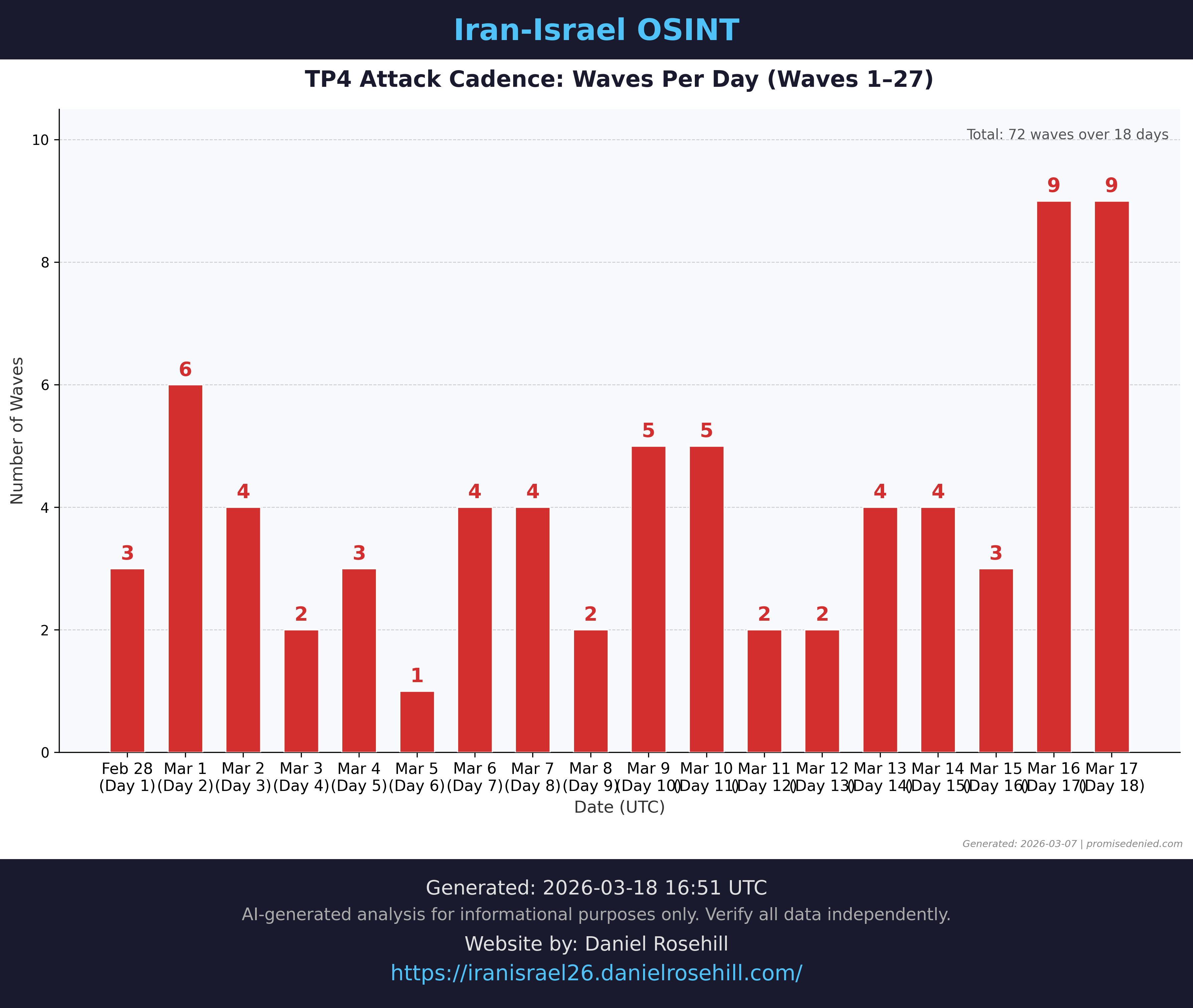
Saturday — Operation True Promise 4 — Day 8 — 4 new waves (24–27)
Summary
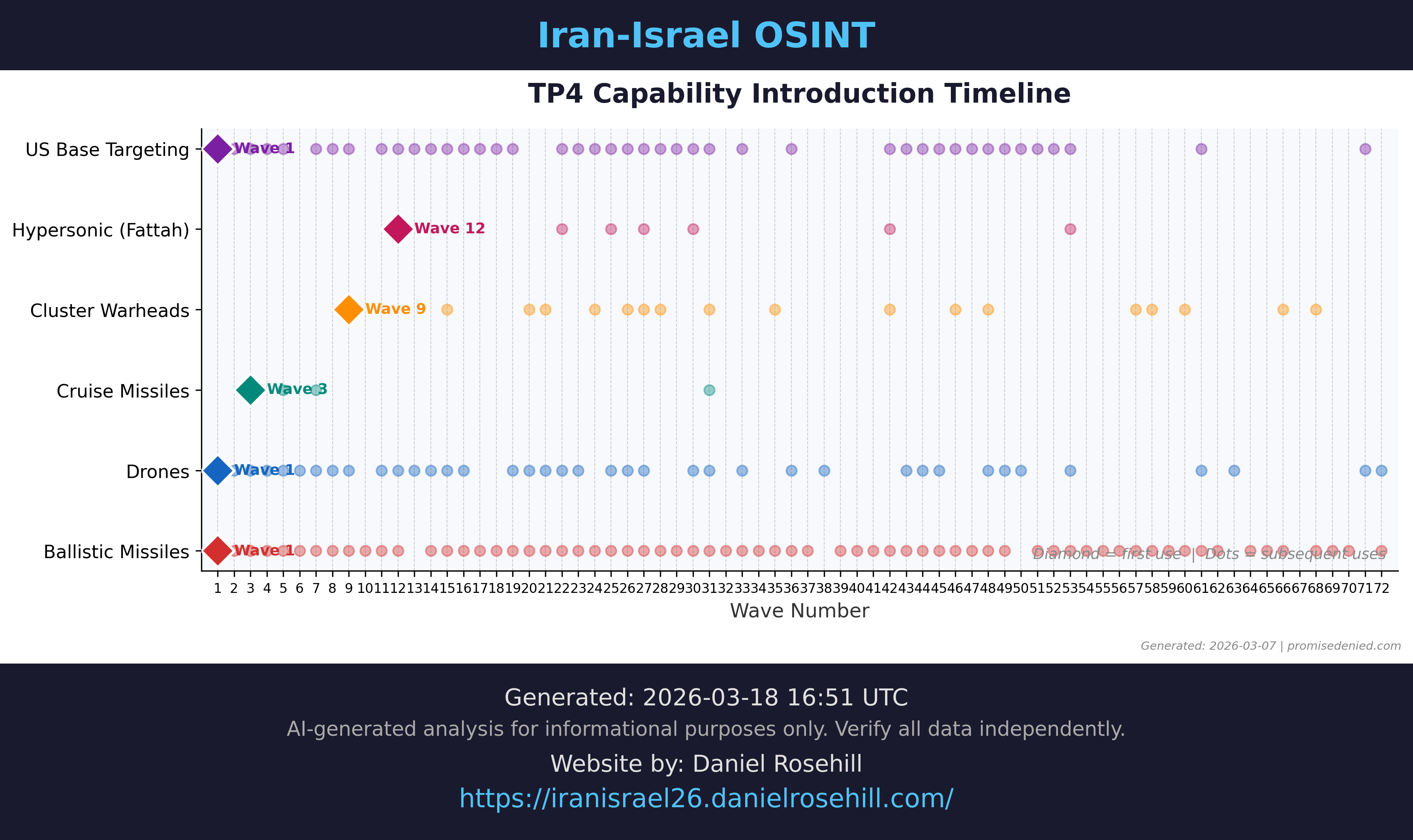
BLUF: Day 8 of TP4 produced four attack waves, the highest single-day wave count of the operation, sustaining heavy bombardment with no indication of ceasefire or operational drawdown. Iran debuted the Fattah-2 — an upgraded hypersonic missile — in Wave 27, extending the qualitative escalation pattern established the previous day with Khorramshahr-4 and the original Fattah. Cluster warheads featured in three of the four waves (24, 26, 27), bringing the TP4 cluster munition wave total to five. Geographic targeting expanded further: UAE and Kuwait were struck across multiple waves, with Iran Army drone strikes explicitly targeting US military facilities at Al-Minhad Air Base (UAE) and Camp Udairi / Camp Buehring (Kuwait). TP4 now stands at 27 waves across 8 days.
Wave 24 (05:30 UTC) opened with a confirmed missile impact in Tel Aviv — at least three impacts reported by Al Jazeera — using Kheibar Shekan and Emad BMs with cluster warheads under the codename "Ya Mahdi." Wave 25 (12:30 UTC) expanded to the UAE, striking Al-Dhafra and Al-Minhad Air Bases with hypersonic missiles described as targeting joint US-Israeli military infrastructure. Wave 26 (17:00 UTC) broadened the attack to Kuwait for the first time, with drones hitting Camp Udairi alongside heavy multi-warhead Kheibar strikes against Israel. Wave 27 (18:30 UTC) deployed Khorramshahr-4 heavy BMs, the newly revealed Fattah-2 hypersonic system, and cluster warheads against the Haifa oil refinery and continued US positions in Kuwait.
Coalition Actions
- Israeli multi-layer air defence engaged incoming missiles across all four waves. At least three missile impacts confirmed in Tel Aviv during Wave 24, per Al Jazeera reporting.
- IDF Home Front Command issued shelter directives four times during the day, with the first alert at 07:30 IST corresponding to Wave 24.
- Cluster submunition UXO clearance operations continued in Israeli population centres from prior waves; new submunition dispersal from Waves 24, 26, and 27 expanded the clearance taskload.
- US forces at Al-Dhafra Air Base (UAE) and Al-Minhad Air Base (UAE) under direct attack in Wave 25 and Wave 26. US CENTCOM defensive posture at maximum alert across all Gulf installations.
- US forces at Camp Udairi / Camp Buehring (Kuwait) targeted by Iran Army drones in Waves 26 and 27; Kuwait is a first-time target in TP4.
- UAE and Kuwaiti air defence systems activated. Battle damage assessment and interception results from Gulf state sites pending open-source confirmation.
- Haifa oil refinery targeted in Wave 27; Israeli emergency services placed on standby for potential petroleum infrastructure fires.
Iranian Actions
- Wave 24 (05:30 UTC / 07:30 IST): Codename "Ya Mahdi" — Kheibar Shekan, Emad, and Ghadr ballistic missiles with cluster warheads against Tel Aviv. At least three missile impacts confirmed in Tel Aviv by Al Jazeera. Described by IRGC as targeting the "heart of the occupied territories."
- Wave 25 (12:30 UTC / 14:30 IST): Codename "Al-Muqaddis / Ali ibn Abi Talib" — Fateh, Emad, and strategic missiles including hypersonic systems, combined with drones. Targets included joint US-Israeli military and logistical facilities: Al-Dhafra Air Base and Al-Minhad Air Base (both UAE). Precision strikes on radar and satellite communications centres claimed by IRGC.
- Wave 26 (17:00 UTC / 19:00 IST): Codename "Ya Heydar Karrar" — New-generation Emad, Ghadr, and multi-warhead Kheibar missiles with cluster warheads, plus drones, targeting Israel north-to-south including the Sdot Micha strategic military radar facility. Separate Iran Army drone strikes against Al-Minhad Air Base (UAE) and Camp Udairi (Kuwait) — marking Kuwait's first targeting in TP4.
- Wave 27 (18:30 UTC / 20:30 IST): Codename "Ya Fatimah al-Zahra" — Khorramshahr-4 heavy ballistic missiles, Fattah-2 hypersonic missiles (first operational use), cluster warheads, and suicide drones. Targets: Haifa oil refinery and US positions at Camp Udairi / Camp Buehring (Kuwait). Cluster warhead use over Israel confirmed.
- IRGC attributed Wave 25 attacks to targeting of joint US-Israeli military infrastructure. No ceasefire or end-of-operations statement issued by end of day.
- The Fattah-2, described as an upgraded variant of the Fattah hypersonic glide vehicle first deployed in Wave 22 (Mar 6), represents Iran's most advanced publicly disclosed missile system.
Waves & Munitions
Wave 24 — 05:30 UTC (07:30 IST)
- Codename: "Ya Mahdi"
- Weapons: Kheibar Shekan, Emad, Ghadr ballistic missiles with cluster warheads
- Targets: Tel Aviv ("heart of the occupied territories" per IRGC)
- Confirmed impacts: At least 3 missile impacts in Tel Aviv (Al Jazeera)
- Cluster munitions: Confirmed
- Landings: Israel
Wave 25 — 12:30 UTC (14:30 IST)
- Codename: "Al-Muqaddis / Ali ibn Abi Talib"
- Weapons: Fateh, Emad, strategic missiles including hypersonic systems, drones
- Targets: Joint US-Israeli military centres and logistical support; Al-Dhafra Air Base (UAE), Al-Minhad Air Base (UAE); radar and satellite communications centres (IRGC claim)
- Hypersonic: Confirmed use
- Landings: Israel, UAE
Wave 26 — 17:00 UTC (19:00 IST)
- Codename: "Ya Heydar Karrar"
- Weapons: New-generation Emad, Ghadr, multi-warhead Kheibar missiles with cluster warheads; Iran Army drones
- Targets: Israel (north-to-south), Sdot Micha strategic military radar facility; Al-Minhad Air Base (UAE), Camp Udairi (Kuwait) via drone strikes
- Cluster munitions: Confirmed
- Notable: First TP4 attack on Kuwait
- Landings: Israel, UAE, Kuwait
Wave 27 — 18:30 UTC (20:30 IST)
- Codename: "Ya Fatimah al-Zahra"
- Weapons: Khorramshahr-4 heavy ballistic missiles, Fattah-2 hypersonic missiles (operational debut), cluster warheads, suicide drones
- Targets: Haifa oil refinery (Israel), US positions at Camp Udairi / Camp Buehring (Kuwait)
- Cluster munitions: Confirmed over Israel
- Hypersonic: Fattah-2 first operational use confirmed
- Landings: Israel, Kuwait
Tactical Assessment
- Highest single-day wave count: Four waves in 13 hours (05:30–18:30 UTC) represents the most compressed and voluminous single-day attack sequence of TP4, suggesting no operational fatigue or resource constraint on the Iranian side.
- Fattah-2 debut: The Fattah-2, an upgraded hypersonic glide vehicle following the Fattah's debut in Wave 22 (Mar 6), signals Iran is progressively stepping through its most capable systems. Successive deployment of Fattah then Fattah-2 within 24 hours suggests a deliberate demonstration sequence rather than resource scarcity.
- Kuwait as new theater: Camp Udairi / Camp Buehring hosts pre-positioned US Army equipment and is a critical logistics node for US Central Command ground forces. Its targeting in Waves 26 and 27 marks a geographic and strategic expansion of Iran's direct engagement with US forces beyond air bases.
- Cluster munition pattern deepening: Three of four waves today employed cluster warheads, compared to two of three on Mar 6. The cumulative five cluster-munition waves in TP4 create an expanding UXO footprint in Israeli population centres and present a sustained humanitarian and clearance challenge.
- Sdot Micha targeting: Sdot Micha Air Base houses Jericho ballistic missile systems and is one of Israel's most sensitive strategic sites. Targeting it with radar-suppression framing suggests an attempt to degrade Israel's second-strike deterrent or at minimum to probe its defences.
- Haifa oil refinery: Wave 27's targeting of the Haifa refinery continues Iran's pattern of escalating against critical civilian infrastructure. A successful strike on petroleum processing would have cascading economic and energy security effects.
- Iran Army vs. IRGC drones: Waves 26 and 27 explicitly attributed drone strikes against Kuwait and the UAE to the Iran Army rather than the IRGC, which may reflect a deliberate institutional signaling of broader governmental commitment beyond the IRGC's revolutionary mandate.
- No ceasefire signals: With 27 waves across 8 days and no public Iranian statement indicating an end to operations, TP4 trajectory points toward continued or intensifying operations into a second week.
Responses & Reactions
- Israel: Multi-layer air defence engaged across all four waves. At least three confirmed missile impacts in Tel Aviv reported by Al Jazeera during Wave 24. Home Front Command issued shelter alerts four times. Ongoing UXO clearance from cluster submunitions expanded with new dispersal in Waves 24, 26, and 27.
- United States: Forces at Al-Dhafra (UAE), Al-Minhad (UAE), Camp Udairi (Kuwait), and Camp Buehring (Kuwait) directly targeted. CENTCOM on maximum defensive alert across Gulf installations. Extent of US casualties or infrastructure damage not confirmed in open sources at time of publication.
- UAE: Al-Dhafra and Al-Minhad Air Bases targeted in Waves 25 and 26. UAE air defence engaged. Damage assessment pending. The UAE hosts significant US air power including F-35s and B-52 detachments; disruption to these assets would carry strategic implications.
- Kuwait: First country in TP4 to be targeted, with Camp Udairi / Camp Buehring struck by drones in Waves 26 and 27. Kuwaiti government statement pending. Kuwait hosts US Army pre-positioned equipment and forward logistics.
- Iran: IRGC and Iran Army issued statements across all four waves. No ceasefire offer or drawdown indication. Fattah-2 presentation framed as demonstration of advanced capability. State media coverage intensive.
- International community: Continued condemnation of cluster munition deployment over populated areas. Ben Gurion Airport's continued targeting and the Haifa refinery strike drew additional international concern over civilian and critical infrastructure escalation. UN Secretary-General's office called for immediate de-escalation. Gulf Cooperation Council states expressed alarm at direct strikes on member-state territory.
Data & Charts
For interactive data and visualizations, see:
- Wave Timeline — All 27 waves in reverse chronological order
- Interactive Map — Launch sites, targets, and bases
- TP4 Data Table — Searchable wave records
- Analysis Charts — Timing, weapons, targets, escalation
- Daily Analysis Blog — Timestamped analysis with embedded charts
Selected charts (generated 2026-03-06, waves 1–23; updated charts pending sync):