TP4 Anomaly Analysis: What the Data Gaps and Pattern Breaks Tell Us
Structured data from 23 TP4 salvos reveals several anomalies — patterns that break from the norm, data gaps that resist easy explanation, and behavioural shifts that may signal operational changes. This post catalogs the key anomalies found in the dataset and offers potential interpretations for each.
1. The Ghost Salvos: 18 and 20
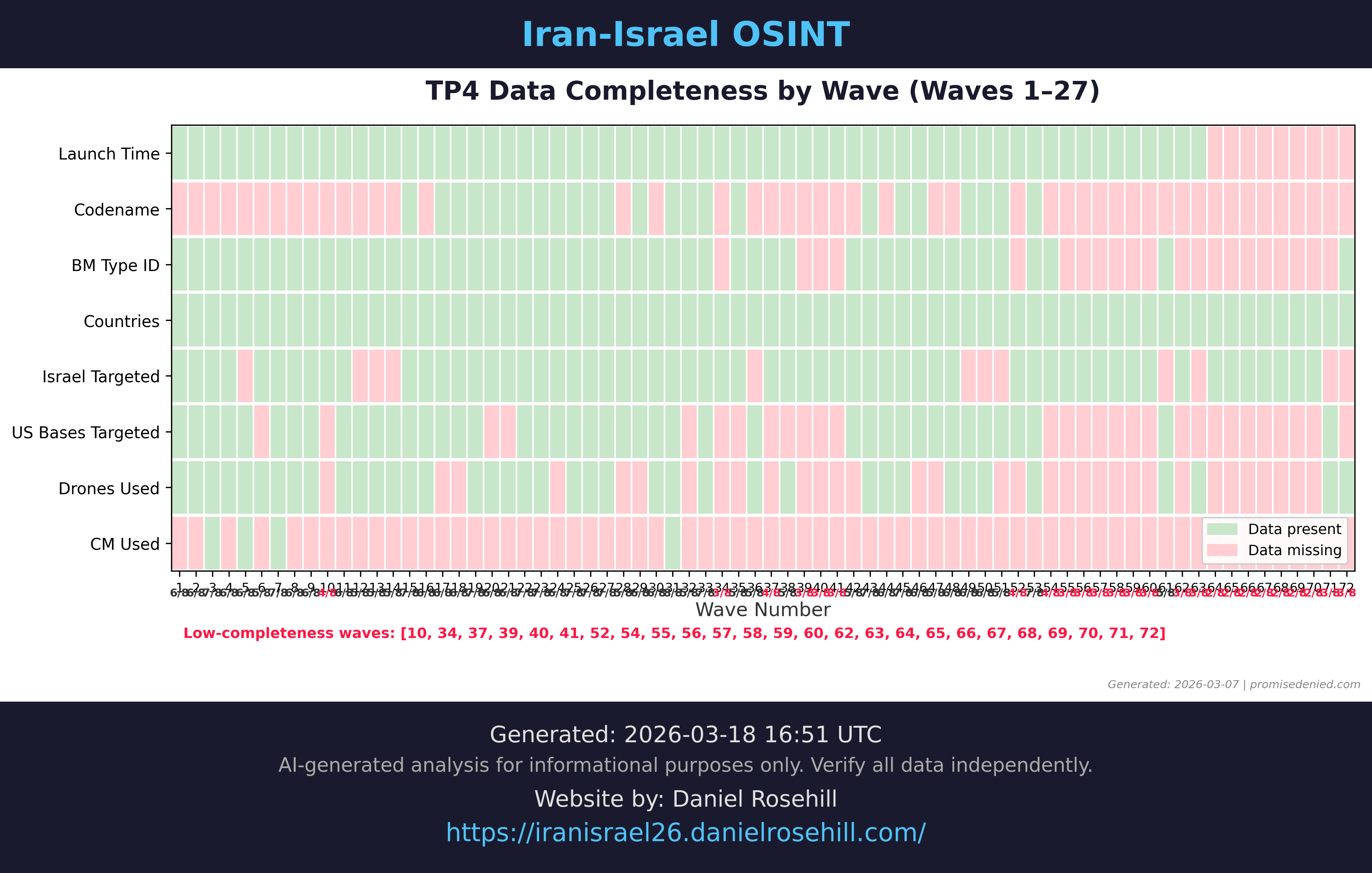
Two salvos in the dataset — Salvo 18 and Salvo 20 — have no launch timing data at all. No probable launch time, no announcement timestamp. Salvo 18 also has no landing countries recorded. These are "ghost salvos" — they exist in the IRGC's announced sequence but their timing is unresolvable from open-source reporting.
Anomaly: Salvo 18
Conflict day: 5 (Mar 4) | Timing: None | Countries: None
Weapons: Ghadr ballistic missiles (only system identified)
Codename: "Ya Imam Hassan Mojtaba"
Anomaly: Salvo 20
Conflict day: 6 (Mar 5) | Timing: None | Countries: IL
Weapons: Kheibar Shekan with cluster warheads, drones
Codename: "Ya Mo'izz al-Mu'minin"
Possible Interpretations
Hypothesis A — Covert launches: These salvos may have been launched without public IRGC announcement, discovered only through impact reports or post-hoc IRGC claims. The lack of timing suggests no real-time announcement was made.
Hypothesis B — Propaganda salvos: The IRGC may have retroactively claimed additional "salvos" to inflate the apparent operational tempo, even if the strikes were part of earlier announced salvos. The codenames suggest official status, however.
Hypothesis C — OSINT collection gap: These may simply reflect gaps in the data pipeline — timing information exists in Farsi-language sources or social media posts that haven't been captured.
2. Timing Anomalies: Four Major Gaps
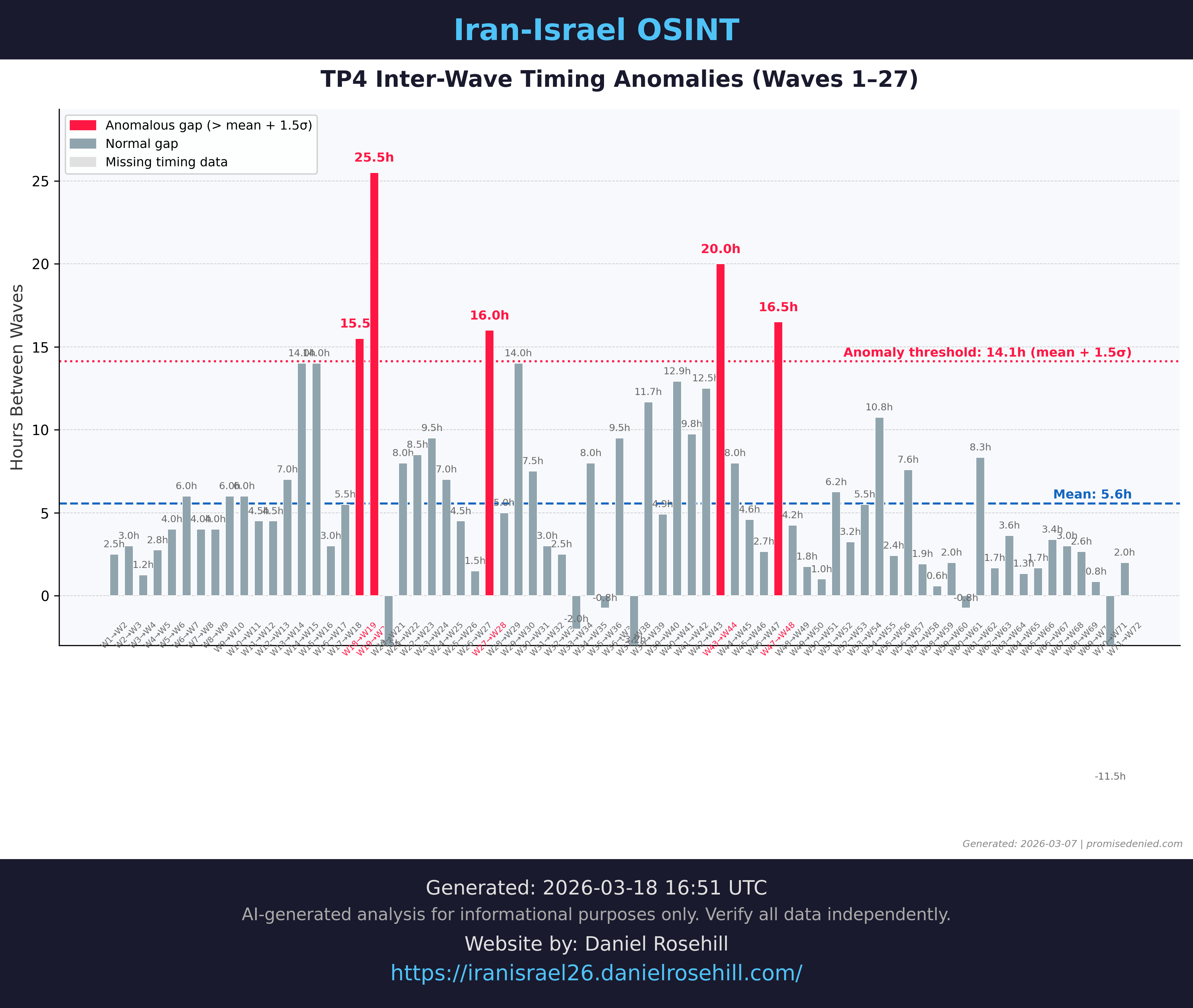
Among the 21 salvos with timing data, four inter-salvo gaps exceed the anomaly threshold (mean + 1.5 standard deviations):
- Salvo 14 → 15: 14.0 hours — overnight pause between Day 3 and Day 4
- Salvo 15 → 16: 14.0 hours — second consecutive overnight pause
- Salvo 17 → 19: 21.0 hours — longest gap (Salvo 18 missing from sequence)
- Salvo 19 → 21: 22.0 hours — the "operational pause" (Salvo 20 missing)
The mean gap between timed salvos is approximately 6.7 hours. The four anomalous gaps are 2-3x the mean. Notably, two of the four coincide with ghost salvos (18 and 20), suggesting the gaps may be partially explained by missing timing data rather than actual operational pauses.
Possible Interpretations
Overnight pauses: The W14→15 and W15→16 gaps align with nighttime in Iran (roughly 22:00-10:00 local). Iran may pause launches during early morning hours for logistical resupply or crew rotation at launch sites.
Ghost salvo masking: The W17→19 gap (21h) would shrink significantly if Salvo 18's actual timing were known. Similarly, the W19→21 gap (22h) may include Salvo 20. The "operational pause" narrative may be an artifact of data incompleteness.
Deliberate tempo variation: Iran may intentionally vary the tempo to keep coalition defences in a state of uncertainty — preventing predictable attack patterns.
3. The Codename Emergence
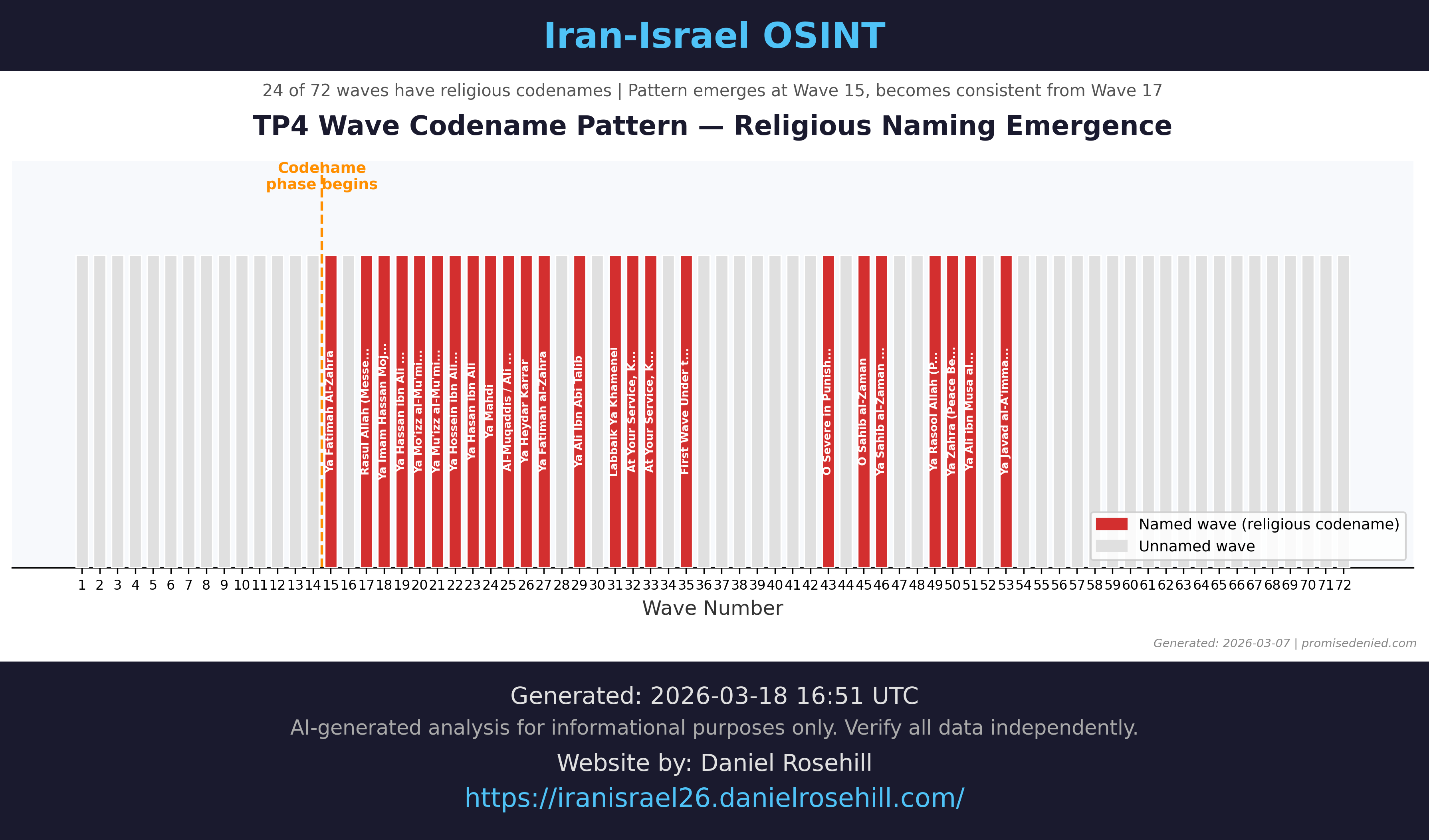
The first 14 salvos had no codenames. Starting at Salvo 15, religious codenames appeared and became consistent through Salvo 22. Salvo 23 again has no codename. The codenames follow Shia Islamic figures:
- W15: Ya Fatimah Al-Zahra
- W17: Rasul Allah (Messenger of Allah)
- W18: Ya Imam Hassan Mojtaba
- W19: Ya Hassan ibn Ali
- W20-21: Ya Mo'izz al-Mu'minin / Ya Mu'izz al-Mu'minin
- W22: Ya Hossein ibn Ali
Possible Interpretations
Escalation signaling: The shift from unnamed to religiously named salvos may signal a deliberate IRGC decision to frame the operation in explicitly religious terms, possibly to secure domestic legitimacy or signal to allies that a new operational phase has begun.
Command authority shift: The codename emergence at Salvo 15 may indicate that a different level of IRGC command took operational control midway through TP4, with higher-ranking authorities preferring formal naming conventions.
Salvos 20 and 21 share a near-identical codename ("Ya Mo'izz al-Mu'minin" vs "Ya Mu'izz al-Mu'minin") — this may be transliteration variation, or it may indicate the IRGC considered these a single operation split across the operational pause.
4. Weapon Identification Gaps
Two salvos — 17 and 23 — are confirmed as using ballistic missiles but have no specific missile type identified. This is unusual: most BM-using salvos have at least one system (Emad, Ghadr, Kheibar Shekan, Fattah, Khorramshahr-4) identified.
Anomaly: Unidentified Missile Types
Salvo 17: BM confirmed, no types, no drones. Codename "Rasul Allah."
Salvo 23: BM confirmed, no types, drone use unknown. IRGC described these as "some of the world's most advanced missiles."
Possible Interpretations
Deliberate ambiguity: For Salvo 23, the IRGC's vague language ("most advanced") may be intentional — either to amplify psychological impact or to conceal the actual systems used from coalition intelligence.
New systems: "Most advanced" may refer to systems not yet categorized in our schema (e.g., a Fattah-2 variant, or a previously untested system). The lack of identification may indicate genuinely novel hardware.
Collection lag: Salvo 23 occurred at 20:00 UTC — the most recent salvo. Specific missile type identification may simply not have propagated through OSINT channels yet.
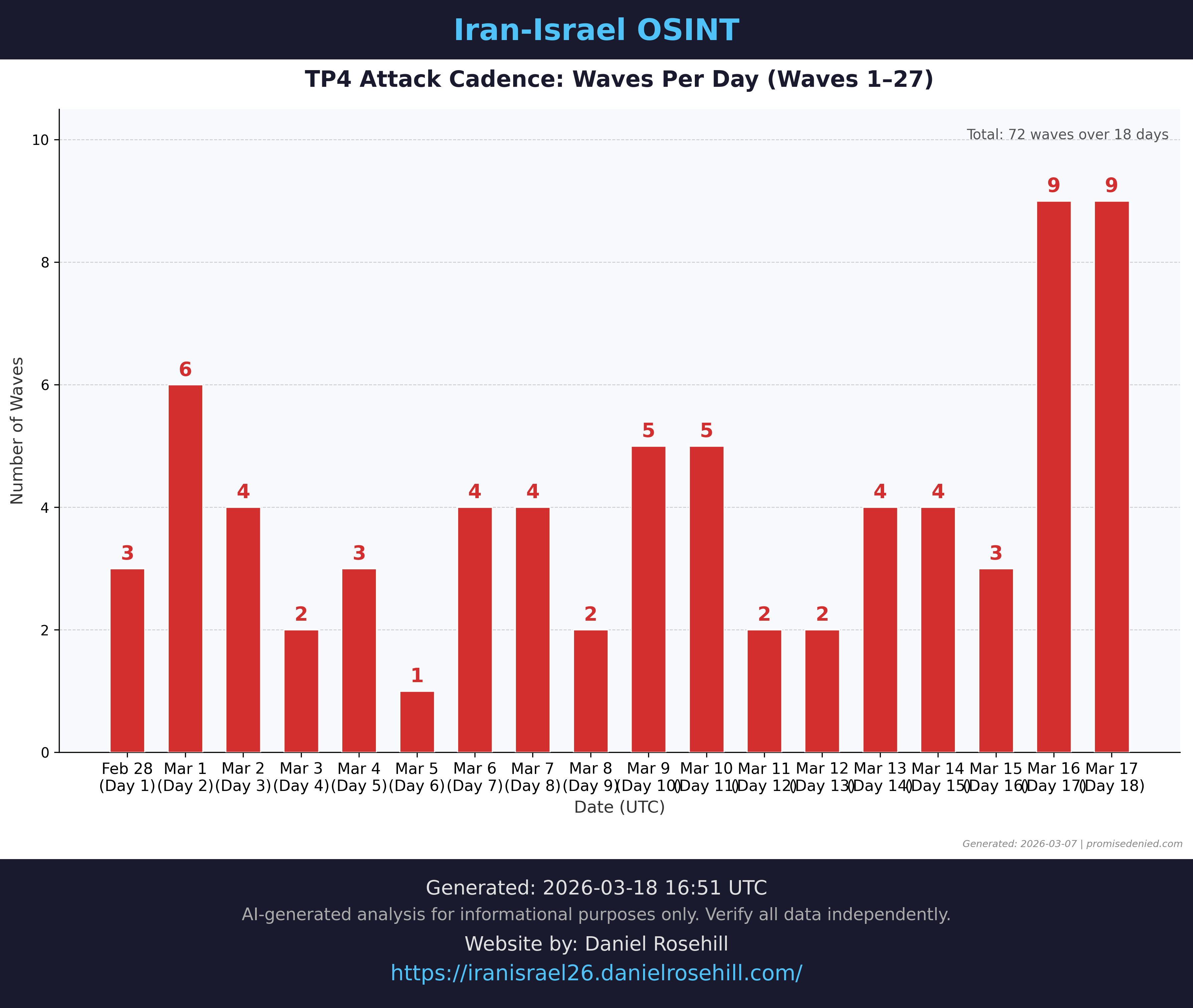
5. The Day 2 Surge vs. Day 4-6 Slowdown
Day 2 (March 1) saw 6 salvos — nearly double any other day. Days 4-6 dropped to just 2-3 salvos per day. This tempo decline could indicate:
- Depletion of pre-positioned munitions after the initial surge
- Shift from volume to precision (later salvos use more advanced systems)
- Coalition defensive pressure forcing longer preparation times between launches
- Deliberate conservation of advanced systems for later escalatory phases
Day 7's three salvos — featuring the most advanced systems yet — support the "quality over quantity" interpretation: fewer salvos, but each carrying significantly more capable and harder-to-intercept payloads.